

Author’s Note: This lightly edited version first appeared on Mad in the UK, republished here with permission. A final Part II will follow.
Politics makes strange bedfellows.
-Louis Dalrymple
Introduction
In her fascinating book The Ideological Brain: The Radical Science of Flexible Thinking, the political psychologist and neuroscientist Leor Zmigrod walks the reader through a philosophical, socio-political, psychological, and neuroscientific understanding of ideology. She demarcates two elements of ideology: rigid doctrine and rigid identity.
She defines the former as “the evidence-resistant absolutist descriptions and prescriptions that guide the believer’s thoughts, actions, utopian hopes, and imagined catastrophes”; the latter is described as the “inventing [of] distinctive identity markers, such as flags, symbols, songs, anthems, costumes, and rituals, which signal membership and devotion. The shared and visible nature of these identity markers fosters passionate feelings of immersion and connectedness with the ideological group…Through these exclusive identity categories, nonadherents are rejected or shunned, and become the objects of hostility and prejudice.”
With Zmigrod’s accounting in the backdrop, we must examine a pernicious and intractable ideology concerning a model within the field of mental health that, notably over the recent handful of years, has been effectively and paradoxically co-opted by a particular ideological and political segment of the population, at least here in the United States. In this two-part essay, I will argue that elements of the left-wing political party and an ideology in the form of critical social justice activism found within it has become ensnared by the biomedical model of mental health—another ideology comprising the waters in which we all swim when we refer to topics about “mental health,” “mental disorders,” “psychiatric diagnoses,” “mental illness,” et cetera.
The former will be defined later in this essay; the latter can be described as the understanding that human suffering and struggles stem primarily from biological factors residing within the individual that are, then, conceptualized as “mental disorders” or putative medical conditions. This anti-progressive and philosophically vacuous biomedical model of mental health contains unyielding critiques that have been shown to not only be arguably more harmful than helpful to the population it is purported to help—by medicalizing,1 pathologizing,2 and decontextualizing3 human suffering—but has also been appropriated by this particular left-leaning segment of the population as they work to achieve their social justice aims in ostensibly progressive ways.
It should be said at the outset that people or ideologies conservative in nature are also complicit in contributing to the problems inherent with the biomedical model of mental health—they rightfully deserve a critique of their own. For example, evidence suggests that right-wing individuals tend to not only stigmatize those suffering and labelled with a so-called mental illness by perceiving them as more unpredictable and dangerous, but they also prefer to be socially distanced from them.
Therefore, to be more precise, the subject of my critique in this essay and phenomenon I hope to illuminate will be the progressive left-wing convergence and interrelation among what has been labelled (including but not limited to) as:
Critical social justice (CSJ): the obsession “with power, language, knowledge, and the relationship between them…This is a world view that centers social and cultural grievances and aims to make everything into a zero-sum political struggle revolving around identity markers like race, sex, gender, sexuality and many others”;
the identity synthesis: a framework that prioritizes group identities (e.g., race, gender, and sexual orientation) as the preferred lenses for understanding social dynamics and structuring political action;
social justice fundamentalism (SJF): the focus on group identities in an authoritarian way as opposed to liberal social justice, the focus on individual rights;
social justice leftism (SJL): an ideological movement that arose predominantly in the university setting that emphasizes identity markers, rejects identity-neutral justice, utilizes the idea of “concept creep” to express grievances, and “exaggerate[s] claims of identitarian victimization” leading some to suggest that there is an “inversely proportional relationship between the intensity of SJL normative claims about identitarian oppression and the degree to which those forms of identarian oppression have been mitigated or eliminated”;
the postmodern/critical theory (PCT) movement: “the framing of the world as a struggle between oppressor and oppressed groups” and the “landscape mov[ing] from class to identity”;
symbolic capitalists and asymmetric multiculturalism: the tendency to adopt or advocate for identities (e.g., neurodivergent, disabled) to gain moral authority and social leverage; and when certain groups are encouraged to organize around identity while others (e.g., neurotypical, the able-bodied) are discouraged from doing so;
and radical social justice theory: “the belief that society is divided into social identity groups defined by categories such as class, race, and gender; that any ‘unfair distribution’ of goods among these groups is oppression; and that oppression can only—and must—be removed by a coalition of ‘marginalized’ identity groups working to radically transform politics, society, and culture to eliminate privilege.”
As the various ideas and definitions illustrate, these kinds of CSJ-like ideologies not only convey a sort of authoritarianism amongst them in their declarations of what is “truth” and how we should work toward a particular kind of “social justice,” they all also have a common thread emphasized and woven throughout: identity.
The Contemporary Landscape
I’ve considered myself to be part of a small but mighty minority across the globe working to not only spread the word about alternative views when it comes to so-called mental illness or disorder, but also contribute in developing other ways—frameworks, philosophies, practical approaches—to help those suffering make sense of their difficulties in non-medicalizing and non-pathologizing ways.
See, for example, the following: ADisorder4Everyone, Council for Evidenced-based Psychiatry, Critical Psychiatry Network, Mad in America, the Inner Compass Initiative, the Ethics International Press Critical Psychology and Critical Psychiatry Series, and the 1st (2017), 2nd (2018), 3rd (2019), 4th (2019), and 5th (2025) Special Issues on Diagnostic Alternatives published by the Journal of Humanistic Psychology.

When joining the mental health profession, I accepted at the outset that this kind of critical work would be a lifelong uphill battle. However, since about 2020, I began to suspect that my “camp’s” work would begin to face an even more uphill battle based on trends I was noticing in the form of offshoots—the “very liberal” who espouse CSJ ideologies listed earlier in this essay—of the left-wing political party co-opting various kinds of identity markers in their work towards achieving various forms of social justice. These markers have included, confusingly and concerningly, controversial psychiatric diagnoses and mental disorder labels.
Studies have shown increasing rates of “diagnosed mental disorders” and worsening mental health for people who identify as liberal or Democrat. Given these trends, one can assume there is a higher likelihood of someone left-leaning being diagnosed and strongly identifying with a psychiatric label. It is also important to keep in mind the phenomenon of not only “self-diagnosing” that doesn’t necessarily translate into actually seeking support, but also “diagnosis-seeking” behavior, the latter of which can be difficult to refute in a clinical encounter given the lack of objective procedures to “rule out” what someone presents with as their presenting problems and self-reported “symptoms.” And if insurance needs to be billed, current regulations, at least in the US, dictate that a codified psychiatric diagnosis has to be applied—people are “pigeon-holed” into the medical model.
Speculations abound as to possible causes for those increasing rates. On the whole, maybe left-leaning people are more open to mental health services than conservatives. Maybe psychotherapy and related support are less stigmatized for the left than it is for the right. Perhaps more pointedly, maybe left-leaning individuals prefer “a formal diagnosis as conferring a special facticity and legitimacy on their suffering” as a way “to imply that their thoughts, emotions, or behavior follow with an important degree of necessity from their faulty biology and that they lack control over themselves in important aspects of their life.”
Maybe psychiatric labels converge to bolster one’s sense of their “lived experience” to point to certain “truths” and override others—a practice that has also been subjected to criticism. Recall al-Gharbi’s take that symbolic capitalists are those who either adopt or advocate for marginalized identities (e.g., neurodivergent, disabled) to position themselves as allies of disadvantaged groups in order to maintain elite status, gain moral authority, and social leverage. Therefore, if people increasingly view themselves through a “psychiatric prism,” one can see how this appeal to medicalize one’s experiences for secondary gains can become a runaway freight train with adverse effects.
Additional reasons for this phenomenon given observations of everyday socio-political discourse may be so that psychiatric labels can provide one with comfort in a plight of “victimhood culture,” “grievance politics,” or ongoing participation in the “oppression Olympics.” Crucially and central to the argument put forth in this essay, this perceived oppression via shared identity markers and aspiration for a rebalancing of power and privilege can be illustrated via the power and privilege wheel. That is:
[A] wheel with “power” at the center and “cisgender man,” “white,” “heterosexual,” “able-bodied,” etc. clustered around the center, with “trans, intersex, non-binary,” “dark,” “lesbian, bisexual, pansexual, asexual,” “significant disability,” etc. at the outer reaches of the wheel, signifying distance from power.
Others have pointed out factions of the left-leaning party’s tendency to not only be more drawn to identity politics in the name of progressivism, but also their proud embracement and encouragement to endorse these ideologies even more, resulting in a narrower, rigid view of our world and the people on it. Again, recall Drake who argues that the PCT movement attempts to conceptualize and frame the world in an overly simplistic binary way, constituting oppressor versus oppressed groups contingent on shared identities.
Similarly, Strom and Lieberman suggest these once-obscure ideologies have effectively “create[d] a permission structure for grievances that often seem to willfully subvert accountability and responsibility” in conjunction with the larger socio-political zeitgeist “gripped by a preoccupation with grievance, characterized by overwrought complaints, the weaponization of victimhood, corroded social discourse, disdain for civility and compromise, and political polarization.”
This collective assessment of CSJ-like ideologies embracing various kinds of identity markers, including psychiatric labels, resulting in a despondent socio-cultural ethos in which people are forcibly slotted into a binary (i.e., oppressed versus oppressor) coincides with Haidt’s view that the contemporary socio-political climate has effectively taught—and liberal-leaning people may be especially susceptible to given the political bent of CSJ and worsening mental health for people who identify as liberal or Democrat—reverse Cognitive Behavioral Therapy (CBT).
That is, this flavor of CBT has effectively promulgated—and people have likely internalized—various kinds of cognitive distortions en masse, such as emotional reasoning, catastrophizing, black-and-white thinking, and fortune-telling. I’d add the certainty trap, coined by Redstone, to be another cognitive distortion at play: that is, “a pervasive cognitive distortion that leads individuals to treat their knowledge and beliefs as definitive and final rather than provisional, particularly regarding contentious social and political issues.”
Connective threads between these theses can be bolstered by ideas put forth in Lukianoff and Haidt’s 2018 book entitled The Coddling of the American Mind: How Good Intentions and Bad Ideas Are Setting Up a Generation for Failure, and Lukianoff and Honeycutt’s empirical claim that the further left a young adult or college student leans, the worse mental health they experience as a result of “social justice fundamentalism.” It has also been observed how the field of psychotherapy has become increasingly politicized—most concerningly, in the consulting room à la “the personal is political” and by a predominantly politically progressive profession.
For example, Redding and Satel track the evolution and various “forces” of psychotherapy over the years and argue that we are currently living in the “fifth force” that is “Social Justice Counselling” (SJC), an extension of “Multicultural Counselling” (see here for an example of an attempt at purposefully injecting CSJ into the teaching of clinical social work). However, SJC deviates from multicultural counselling in similar ways to CSJ-like ideologies: whereas multicultural counseling personalizes support for clients predicated on their worldviews, cultural values, and the context in which they live, SJC imposes an overly simplistic binary. Redding and Satel go on to say:
Changes in the client’s ecology may be more effective in alleviating client distress than psychotherapy alone. The social justice therapist can significantly enhance overall treatment effectiveness by taking on the role of ad hoc social worker for the client, helping him or her to access services and working with others to address troubling aspects of the client’s life. Yet, if it is a mistake to assume that a client’s problems are mostly intrapsychic in nature, it is equally mistaken to assume that they are mostly due to environmental pathologies or systemic “oppression”…Telling clients that their problems are due to oppression and discrimination may have the unintended effects of decreasing their internal locus of control and sense of agency, perhaps instilling learned helplessness, depression, and anxiety. Moreover, it often is not possible to affect the client’s ecology – some situations will simply require the client to adopt more resilient coping skills.
Redding and Satel add that although any sensible psychotherapist will keep in mind environmental and contextual factors influencing the client’s distress, the SJC clinician “violates core tenets of sound and ethical psychotherapy when their therapy work is driven by a commitment to furthering their own political causes or grinding a political axe” through the imposition of an ideology that, again, compulsorily dichotomizes people into an “oppressor” or “oppressed” group based on identity markers, including the client sitting in front of the SJC clinician.
Identity
As foreshadowed earlier in this essay, the curious thing is how some people of this stripe within this political leaning tend to identify strongly with psychiatric labels. Not only do topics about mental health and disorders permeate everyday public discourse as well as various social media sites and apps, such as Instagram and TikTok, but some individuals of this political bent tend to speak about themselves through the lens of their mental disorder labels—and even include their psychiatric diagnoses (e.g., “AuDHD” meaning “autism” + “attention deficit hyperactivity disorder [ADHD]”) and disabilities (e.g., “neurodivergent”) in their bios across various platforms, typically accompanied by some sort of social justice element or emphases on other kinds of identity markers.

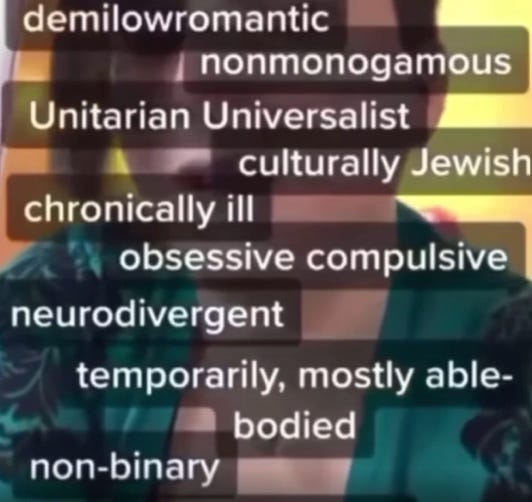
It is also common to view videos on YouTube or commentary articles or blog posts about political or social justice-related topics with people sharing how they identify, for example, “as someone who is ‘bipolar’,” “as someone who is neurodivergent” or “on the spectrum,” or as “someone with ‘PTSD’ or ‘depression’.” For example, I recently came across an online bio of a mental health professional who supports the transgender population identifying as an “autistic individual with dynamic disabilities and many more historically excluded disabilities.” Relatedly, I also came across the bio of an academician who identified as “white, Jewish, nonbinary, disabled, chronically ill, neurodivergent (AuDHD), polyamorous, queer fat Femme” who is a “social justice activist” and whose research foci are about “disability and ableism (including neurodivergence, Mad studies and disability justice), sexuality and sexual health (including reproductive justice), and queer and trans affirming practice (in behavioral, physical and sexual health spaces).”
The authors of a recently published controversial piece of research that yielded a US Office of Civil Rights complaint identified themselves in their article as “I am a white, transgender, queer, and disabled PhD student” and “I am a proud Mexican cisgender woman. I am also able-bodied, heterosexual, spiritual, and middle class.” Another recently publicized event at a New York university centered on how a “queer polyamorous neurodivergent woman teaches workshop on ethical non-monogamy.” Or, to tie back in the idea that perhaps some individuals prefer “a formal diagnosis as conferring a special facticity and legitimacy on their suffering,” consider the Kansas City alleged teenage arsonist who, despite attempts to keep this individual in custody due to risk to public safety, was released from federal custody due to “[c]ourt records say[ing] he has been diagnosed with autism spectrum disorder, ADHD, depression and gender dysphoria, and requires daily medication and treatment” such as gender-affirming care.
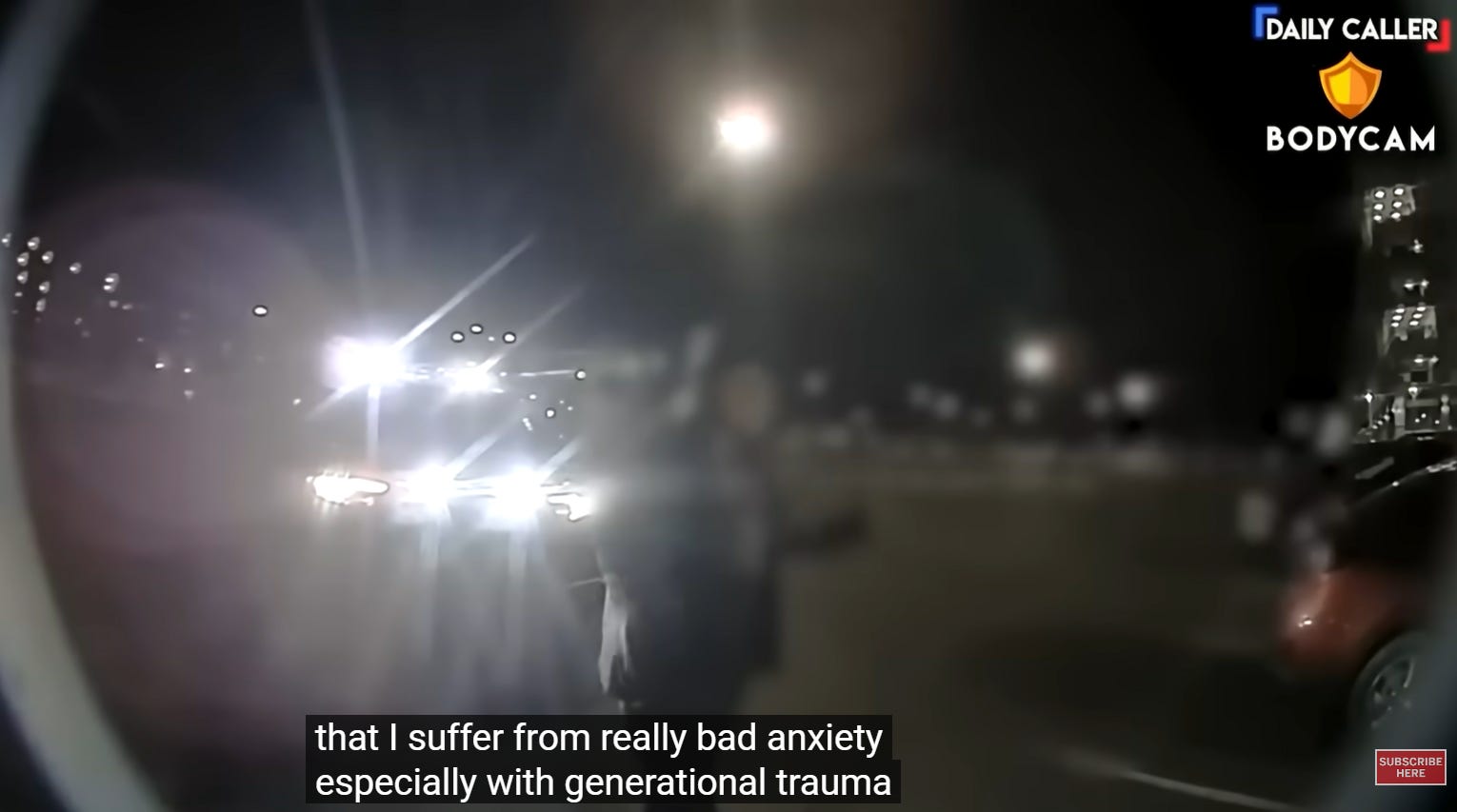
These examples are clear references to people’s propensities for identifying with many, many labels infused with CSJ-like flavoring: a conglomeration of identities, providing some with a sort of protective shield to ward off any kind of criticism—“a way for some…to express negative emotions in a way that, rather than stigmatizing them, makes them feel part of a community and even unique and special.” In this vein, perhaps identity-based labels—and psychiatric ones, in particular—contribute to and make up part of Lukianoff and Haidt’s idea of vindictive protectiveness: that is, the attempt to shield people from words, subjects, topics, and ideas that may cause the person to experience offence or discomfort and simultaneously punish those who have reportedly inflicted the psychological harm.
Again, I do not disagree that people who are more politically conservative are not immune from identifying strongly with psychiatric labels in public ways. However, it has been difficult to find similar presentations of conservative individuals publicly describing themselves in these kinds of ways en masse—but, perhaps, the reader can correct me. As such, my claim here is that—especially when everyone was relegated to their homes during the pandemic—the internet, social media, political turmoil, omnipresent “therapy culture,” the emerging CSJ zeitgeist spilling out of the ivory tower, and everyday discourse have and continues to play a significant role in shaping how people see themselves through a psychiatric prism with mental disorder labels strongly molding their sense of identity.
Arnoldo Cantú, LCSW is a clinical social worker and psychotherapist with experience in school social work, private practice, community mental health, and primary care behavioral health seeing children, adolescents, families, and adults. Cantú was born in Mexico and considers Texas home having grown up in the Rio Grande Valley, though currently resides in the beautiful city of Fort Collins located in northern Colorado. He has been the lead and co-editor of several volumes in the Ethics International Press Critical Psychology and Critical Psychiatry Series. He's written critically and philosophically not only about the idea of so-called mental disorder, but also the idea of race categories. He is also critical about ideological bent and the lack of viewpoint diversity in his profession of social work.
We can define this as the process in which everyday aspects of the human experience are repackaged as medical problems (therefore, pathological) and subjected to medical intervention (e.g., psychiatric drugs, electroconvulsive therapy).
A definition provided by Merriam-Webster is sufficient for this article: to characterize as psychologically abnormal (see https://www.merriam-webster.com/dictionary/pathologize).
And we can define this as “the tendency of the DSM, and psychiatric nosology generally, to fail to acknowledge the fundamental way in which mental distress—its distribution, manifestation, and meaning—are determined by and situated in social structures and cultural meaning-systems.”
Good stuff. Fine-scaling is useful, but it's also important to remember that the domination of public discourse with these types of labels also shifts the fundamental psychosocial axis toward external definition and low agency -- and that changes how brains are wired. You (and everyone else) are a LABEL -- not a person. This fundamentally creates certain types of networked social structures, which do NOT evolve people past their label.
It also makes people more irrational. I have a whole blog on this if you're interested. Starting here is not a bad place to start: https://empathy.guru/2015/06/04/independent-vs-externally-defined-trust-vs-loyalty/
I found the described trend concerning, three decades ago, when certain cohorts began pathologizing ordinary eccentricities. The element of social contagion was present, but appeared to be largely confined within pair-bonds and close associates such as members of extended families.
What was most concerning, was the rigidity of the self-diagnoses. Rather than being a platform from which to gain self-awareness and foster personal growth, there seemed to be a burgeoning reliance on the diagnostic label itself, a reliance that rigidified maladaptive ideation.
At the time, the self-sorting into affinity groups didn't seem to correlate with existing patterns of unrelated political activism and agitation; that pattern emerged with the offspring of those original cohorts, who were older adolescents and young adults at the time.
Stepping back and viewing the trend and its resulting fusion with identity movements, the correlative pattern appears to be one of collectivization. This is congruent with the author's observations regarding leftism and its proclivity toward reifying neuroticism.
An internalized feedback loop has formed. It must be noted that postmodern theories of power distribution aren't entirely spurious, however misdirected their application. What is most concerning, has been the elevated expression of dark triad traits. Mapping the emergent organizational structures, the loci of hierarchical establishment, has exhibited Machiavellianism first and foremost at the leadership level.
This is to be expected; the "useful idiot" aspect of political organizing will always rely on that trait first and foremost. The pattern is now easily recognizable, and it is with a rather horrified fascination that I contemplate it. The feedback loop has strong elements of externally-induced adaptive learning, and the resulting behaviors also indicate an application of external reinforcement.
Under (previously) ordinary circumstances, neuroticism tended to be self-limiting because it is maladaptive. The focus on modifying externalized ecosystem, is the political aspect. If we consider this within the context of desistance from reactivity to conditioned stimuli, the flattening of emotional response that results from uptake of psychoactive medication, appears to have created self-reinforcement that inhibits a normative response to environmental feedback.
However troubling the trend was when it was forming, I didn't fathom what it would lead to, not then. We now face a burgeoning crisis of competence, and I'm beginning to think that all other behavioral crises currently bedeviling society are downstream from that.