


Note: This is a guest post from Peter Jenkins, a counsellor, supervisor, trainer and researcher in the UK and a member of Thoughtful Therapists.
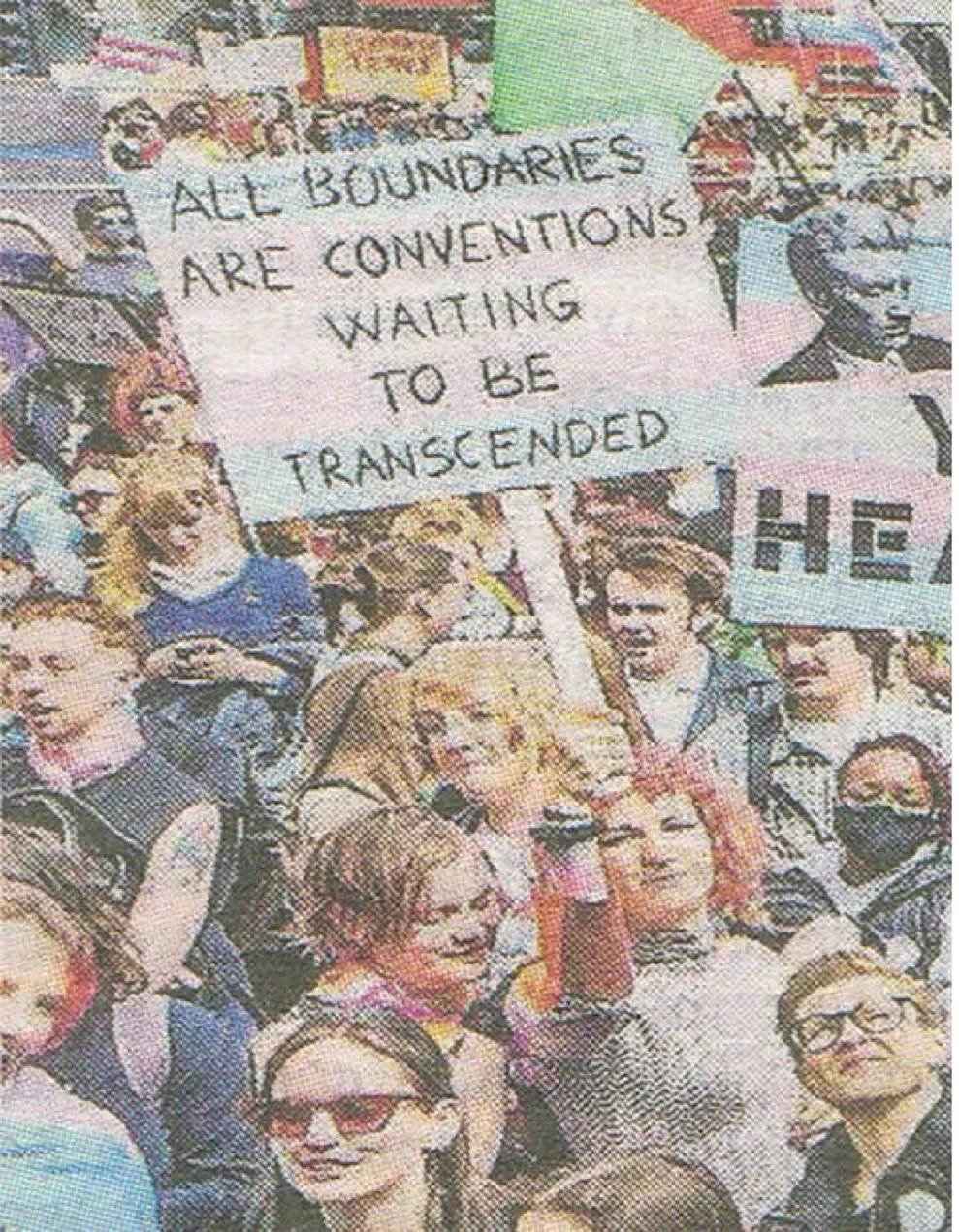
Trans demonstration against UK Supreme Court ruling in April 2025 on the biological nature of sex within the Equality Act 2010.
EDI (Equity, Diversity and Inclusion) comes at a high social cost. Promoting the voices of those claiming lived experience means silencing the views of those with apparent privilege. For the past decade, trans policy has been one of ‘No debate’ and a refusal to debate trans experience with critics. The balance of power enabling this censorship has recently shifted. In the past months, there have been two notable debates about gender identity. The first of these was held in Canada between Mia Hughes, (Genspect, Canada; The WPATH Files) versus Morgane Oger, prominent trans activist (Oger Foundation). The second was held in the UK between Helen Webberley (GenderGP) and Helen Joyce (Sex Matters; Trans). There are other examples in the UK involving Helen Webberley, with journalists Julie Bindel and Andrew Gold, which are not discussed here, but seem to broadly follow the template outlined below.
Comparing the two debates, it is striking how a trans activist and a trans ally rely on using very similar tactics in the discussion. This apparent parallel tells us something important about the resilience and global inter-connectedness of gender identity ideology. This brief analysis focuses on the specific tactics used by Morgane Oger and Helen Webberley, rather than on the main content of their arguments. It does not consider the responses by Mia Hughes and Helen Joyce, who are to be congratulated for presenting their rational counter-arguments to gender identity ideology.
The template uses three key tactics, namely using ad feminam personal attacks, discrediting non-practitioner roles as providing invalid opinion and appealing to higher authority for conclusive support.
Making personalised ad feminam attacks:
Helen Webberly attacks Helen Joyce’s sex-based language in two instances, firstly alleging “…it’s a very dangerous thing to associate transgender women with predatory men” (7.08); and then in relation to Joyce’s description of a transgender woman as a man, which the “Crown Prosecution Service would consider that as a hate crime” (13.29). Morgane Oger makes a series of direct attacks on Mia Hughes’ veracity: “you say some things that are verifiably untrue” (37.46); “It’s not exactly truthful ... It’s a little disingenuous” (59.55); “…it’s actually not true…” (1.26.06); “…I think you are completely misrepresenting the situation” (1.54.04).
Discrediting non-medical and non-practitioner roles and opinions:
The second common tactic is seeking to discredit Mia Hughes’ and Helen Joyce’s standing in the debate, by appealing to a hierarchy of roles which are firmly linked to established systems of status and power. Hence Helen Webberley: “…you’re not a biologist. You’re not a doctor” (4.06); “I’ve never known a medical condition or a medical treatment being debated by mathematicians and statisticians saying it shouldn’t be available…” (21.24); “…we have non-medics interpreting…” (21.30); “…we’ve widened this out to non-medics to have an opinion on what a patient can have. …I can’t equate it with any other medical condition” (21.24). Morgane Oger echoes this approach, with attempts to discredit Mia Hughes, referring to “Mia and some other non-practitioner viewpoints” (1.25.53); and flatly stating: “You are not competent to show the data” (1.26.18).
Appealing to higher medical authority:
Finally, both Morgane Oger and Helen Webberly claim justification by appealing to higher established authority, namely that of WPATH, the World Professional Association for Transgender Health. Not only are Mia Hughes and Helen Joyce non-medics or non-practitioners, but their views are deemed invalid because they are also contradicted by an established medical source with supposedly conclusive authority. Helen Webberley describes WPATH as providing “…the global, internationally recognised standards of care, peer-reviewed by over 210 gender studies” (21.29). For Morgane Oger, WPATH “…is an organisation that includes medical practitioners who have very high reputation except in Mia and some other non-practitioner viewpoints” (1.25.53). (This jibe seems particularly ironic, given Mia Hughes’ standing as author of The WPATH Files, which has provided a devastating critique of this organisation as an advocate of trans ideology.)
Conclusion:
Putting aside the actual content of the debate, it is striking how Morgane Oger in Canada and Helen Webberley in the UK use such similar tactics in attempting to dismiss the arguments presented by their opponents. These tactics include making personalised ad feminam attacks, discrediting the relevance and standing of their opponents’ non-practitioner/non-medical roles and opinions as being invalid within this debate and appealing to supposedly conclusive higher medical authority. For a political ideology frequently lauded as being liberal, progressive and in the vanguard of social change, gender identity ideology here reveals itself as being profoundly regressive, conservative and reactionary in its nature.
References:
Mia Hughes and Morgane Oger debate Gender Identity, Jonathon Kay as Moderator. Heterodox Academy, Wellington, Ontario, Canada. 23rd October, 2025.
Helen Webberley, Helen Joyce, Jo Coburn: The Times Radio gender debate. Times Radio. 20th November 2025.

By Peter Jenkins, counsellor, supervisor, trainer and researcher in the UK. He has been a member of both the BACP Professional Conduct Committee and the UKCP Ethics Committee. He has published a number of books on legal aspects of therapy, including Professional Practice in Counselling and Psychotherapy: Ethics and the Law (Sage, 2017).
Peter is also a member of Thoughtful Therapists (UK). His critique of the UK Memorandum of Understanding on Conversion Therapy (MOU) was described as ‘instrumental’ in persuading the United Kingdom Council for Psychotherapy Board of the case for leaving the MOU in 2024.
Reposted with permission from Critical Therapy Antidote.
Thanks for pointing out my error! Too many Helen's for my brain to cope with...we will correct this asap.
I think the authors meant to write Helen Joyce; not Helen Webberley in the sentence, "It does not consider the responses by Mia Hughes and Helen Webberley, who are to be congratulated for presenting their rational counter-arguments to gender identity ideology." I've watched a couple of the Webberley debates and Webberley did not sound rational to me.