

The Great Replacement (Stop Noticing It)
I remember the first day of my PhD at the University of North Texas when I started to do some noticing. During that first day, we had the entire business school in one room. Of course, I only saw two white people, myself and another. I’ve gotten used to it at this point. But then it got weird. We started going around the room, and it became clear, no one in this room was from America except another student and myself. Out of a room of 40 new admits, 95% were not from the United States.
Again, this is something I’m kind of used to at this point, but this was a bit much. I mean, were there really that few American candidates that they had to import 95% of the class?
The New Corporate Horror: Insourcing
We are all familiar with outsourcing at this point. It’s the reason you call your bank, and a person in the Philippines picks up. It was a bit subtle at first. You call outside office hours, and you might get a person using their “American” name over the phone — “Hello, this is Brian,” — in an accent that makes it painfully obvious his name is not Brian.
But outsourcing at least had one mercy: distance.
The job left. The worker left. The loss was brutal, but it was geographically and psychologically removed. You could still pretend it was unavoidable. Global forces. Inevitable change. The invisible hand.
Insourcing is different.
Insourcing is what happens when the job does not leave the country, but the worker does.
This is the new corporate horror. And almost no one has named it. No one seems to be able to put this new horror into words, so I will call it right here. You are being insourced.
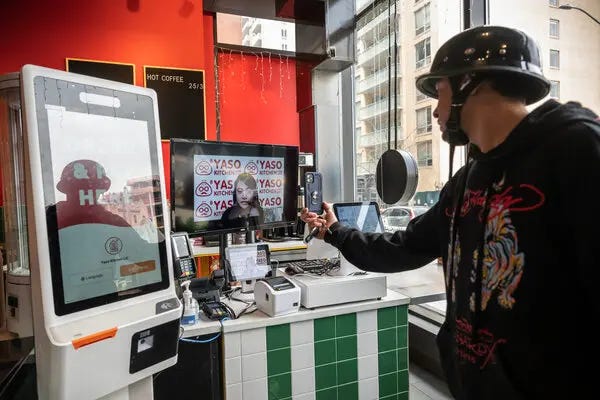
What is Insourcing?
Insourcing is the practice of importing foreign labor to replace domestic workers inside the United States itself. Not to supplement. Not to fill true shortages. To replace.
It achieves the same goal as outsourcing:
• Lower wages
• Reduced bargaining power
• Greater managerial control
But it does so without moving a single office or factory overseas.
The worker comes to you.
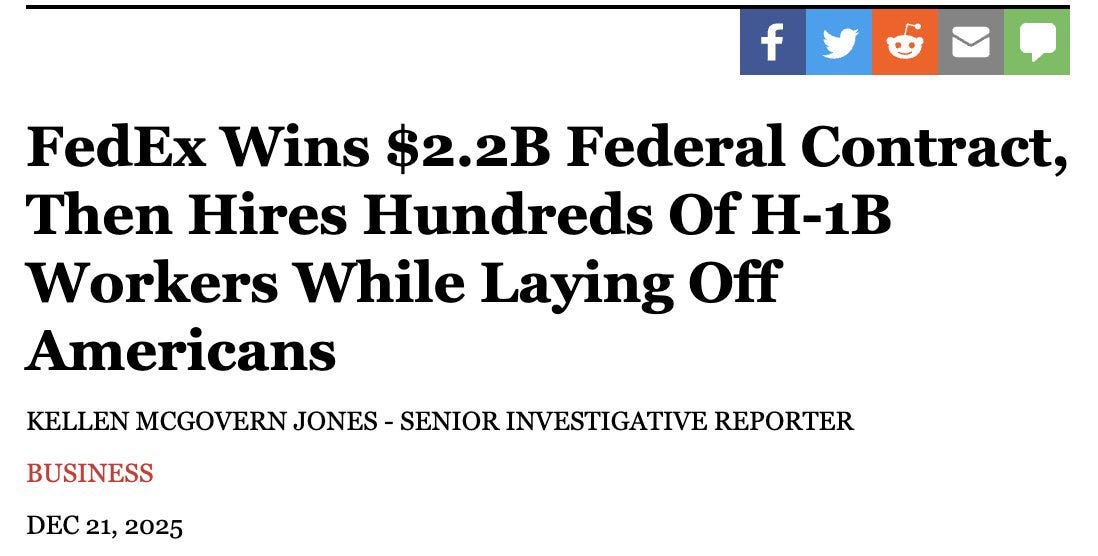
Instead of shipping the job abroad, corporations ship in the labor. Same arbitrage. Same savings. Far fewer complications.
And unlike outsourcing, you cannot turn it off by reshoring. The replacement is already here.
No one voted for this.
No one approved this.
No one asked how this affects American families who used to take pride in their work.
But this shift wasn’t based on competence, or shortages, or the mythical “work Americans won’t do.” Of course, no one ever asked American’s if they would do it, because they didn’t want to hire American’s. They’re too expensive. Easier to hire indentured servants from India. They’re one screw up from your revoking their visa, so they’ll work as long as you want.
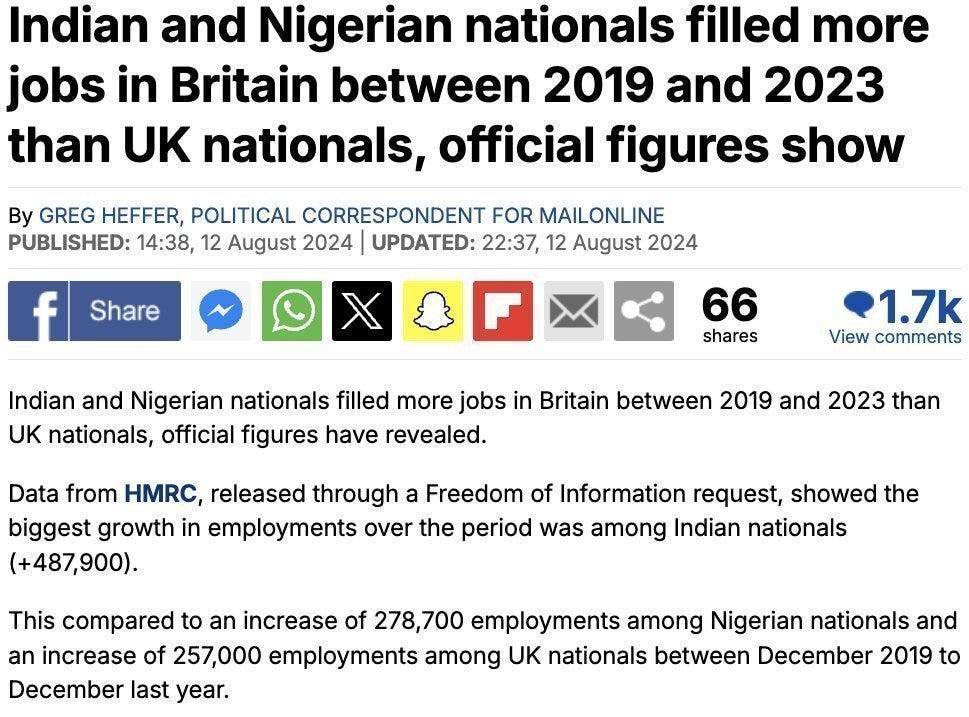
Indentured Labor and Wage Suppression
Indentured labor systems emerge whenever elites seek to reduce labor costs without formally abolishing free labor. The structure is consistent across history, regardless of moral framing.
Core features of indentured labor systems:
• Legal freedom paired with economic immobility
• Employment contracts that restrict exit or retaliation
• Dependency on a single sponsor or owner
• Asymmetric power between worker and employer
These features do not require ownership. They require leverage.
Historical Example: Indentured Servants in Colonial America
Indentured servants in the 17th and 18th centuries were not slaves, but they were not free laborers either.
• Contracts bound them to employers for years
• Leaving early resulted in legal penalties
• Wages were fixed or nonexistent
• Employers exercised near-total control
The economic effect was immediate and well-documented:
• Free laborers faced downward wage pressure
• Skilled trades were devalued
• Labor mobility declined
• Employers preferred bound labor over free workers
Indenture did not coexist neutrally with free labor. It displaced it.
Slave Labor as an Extreme Case
Slave labor represents the endpoint of this same mechanism.
Where slavery existed:
• Labor costs approached zero
• Free labor could not compete
• Wages for non-slave workers stagnated or fell
• Economic power consolidated among owners (Why is everything owned by corporations?! Hmmmm…)
This is why regions dependent on slave labor consistently underdeveloped diversified wage markets. The presence of coerced labor collapses the labor price floor.
Modern Parallel: Visa-Tethered Labor
Modern guest-worker and temporary visa programs replicate the same economic constraints without explicit ownership.
Examples include H-1B, L-1, H-2A/B, and OPT arrangements.
Functional similarities:
• Worker’s legal status depends on employer sponsorship
• Job loss risks deportation
• Switching employers is restricted, delayed, or impossible
• Complaints invite retaliation through visa revocation
From an economic standpoint, this creates a de facto indenture.
Wage Effects in Practice
Employers gain access to a labor pool that:
• Accepts below-market wages
• Cannot credibly threaten to quit
• Cannot unionize effectively
• Cannot litigate without existential risk
The predictable outcome:
• Wage suppression across the sector
• Displacement of domestic workers
• Increased employer leverage
• Declining job quality even for retained workers
American Companies: You’re Bad, and You Should Feel Bad
The death of shame has been so much worse than we thought it would be. I could have never predicted insourcing. I mean, I really thought we had a modicum of national pride. Unfortunately, globalism has convinced everyone that they’re part of some fake global community. Well, really only the Western, White ones.
Let me be very clear, there is no global community. You are either an American or you are against the entire world.
There is always someone in the third world who will take $14 dollars an hour in lieu of your $28.
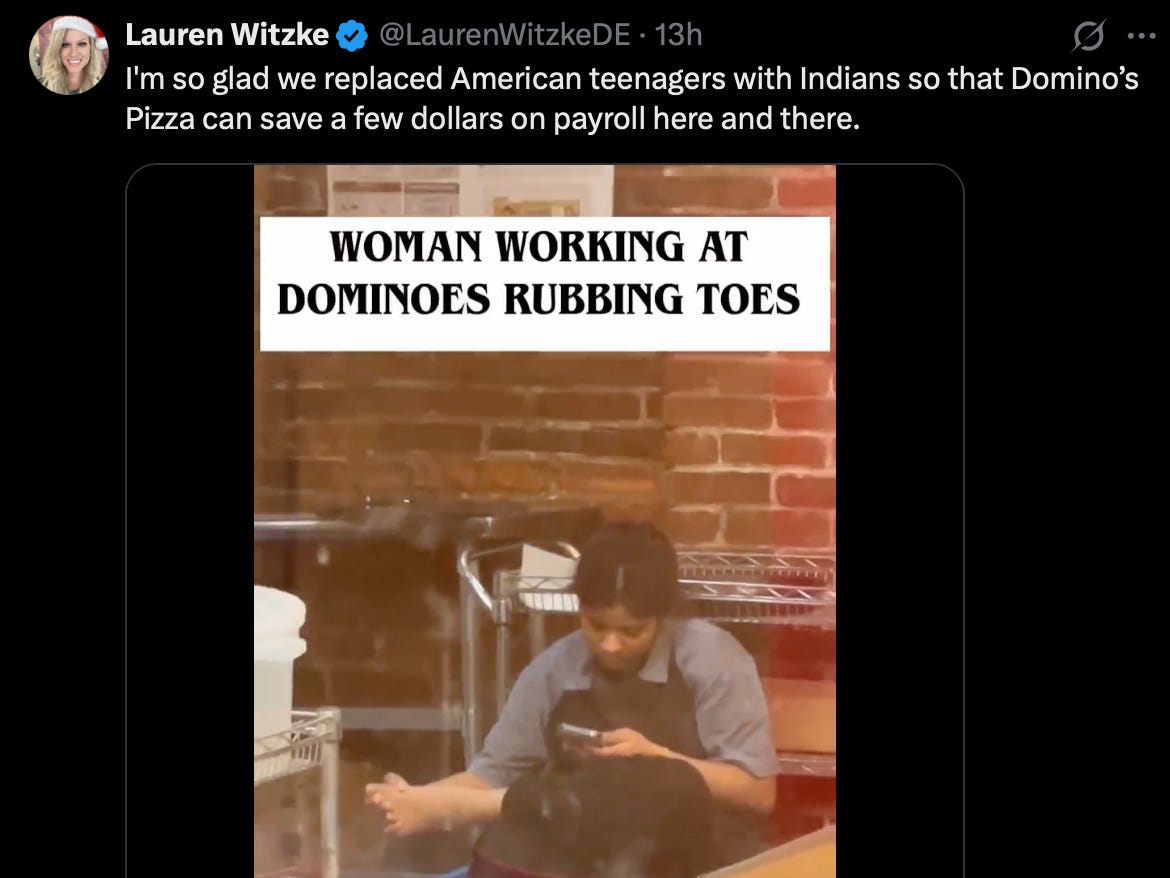
Call it “diversity.”
Cash the bonus.
And when the quality collapses?
Blame the consumer.
It’s not “immigration.”
It’s labor arbitrage and justified as compassion.
“Strength through diversity.”
No, it’s cheapness through disloyalty.
And the message to the entire working population of this country is crystal clear:
You are optional.
Your replacement just arrived on a flight subsidized by your tax dollars.
Even the “most patriotic”, the most “military friendly bank”, has sold out. No one is safe.
The Visa Scam: H-1B as a Replacement Pipeline
If you want to understand insourcing, you have to understand the H-1B visa. The public has been sold this fantasy for decades, that the H-1B program brings in the “best and brightest” from all over the world. A high-skill talent infusion to keep America competitive.
That’s a dog faced lie.
Here’s the truth:
More than 70% of H-1B visas go to entry-level jobs requiring no advanced skill.
Most of these workers are placed into basic IT, customer service, and routine office roles.
They aren’t replacing geniuses, they’re replacing you.
The H-1B is not a “shortage” visa.
It’s a wage suppression visa.
A few ugly facts:
• Companies are legally allowed to pay H-1B workers up to 40% less for the same job
• Those workers are indentured, tied to their employer by visa status
• The worker can’t complain, can’t leave, and can’t negotiate, ever
• If the job demands submission? They submit.
Who benefits?
The same people who gutted your town with outsourcing.
Silicon Valley billionaires, corporate lobbyists, and the political class they bought.
They discovered the perfect worker:
✔ Cheaper than an American
✔ More compliant than an American
✔ Zero leverage compared to an American
The H-1B is a citizen displacement program.
And every time an American tech worker trains their replacement, the executives celebrate another victory:
Replace the expensive worker with a desperate one.
Call it “innovation.”
Call it “global competitiveness.”
Pray no one notices who’s profiting.
Even when performance collapses, the boardroom doesn’t care. They saved 15% on labor costs. The quarterly report looks great. Meanwhile the American who built the system is standing outside the building with a severance check and a box in his hands. They now have a permanent indentured servant who they can keep under their thumb, with the threat of being sent home to keep them working.
Why Corporate Elites Do Not Feel Loyalty
A Psychological Mechanism for National Betrayal
At first glance, it seems irrational that executives would undermine their own country’s workforce for relatively modest cost savings. This behavior appears immoral, short-sighted, and even self-destructive. But psychologically, it is neither random nor mysterious. It is the predictable outcome of a specific moral and cognitive configuration that emerges under globalized elite conditions.
The key mechanism is moral disengagement combined with elite abstraction.
Moral Disengagement at Scale
Albert Bandura described moral disengagement as the process by which individuals deactivate ethical self-regulation in order to engage in harmful behavior without experiencing guilt. Crucially, this does not require malice. It requires distance.
Corporate decision-makers do not experience themselves as firing Americans and replacing them with foreign labor. They experience themselves as:
• “Optimizing labor efficiency”
• “Maintaining shareholder value”
• “Remaining globally competitive”
The human consequences are abstracted into spreadsheets, compliance memos, and HR language. When harm is statistical rather than personal, moral intuition shuts down. The displaced worker becomes a line item, not a neighbor.
This is not sociopathy. It is bureaucratic moral anesthesia.
Elite Cosmopolitan Identity Dissolution
National loyalty depends on identity salience. You protect what you identify with.
Modern corporate elites increasingly do not identify as American in any meaningful psychological sense. They are:
• Educated in transnational institutions
• Socialized into global professional networks
• Rewarded for mobility rather than rootedness
• Insulated from the downstream costs of policy decisions
Their identity is not national. It is class-based and portable.
When identity shifts from “citizen” to “global manager,” loyalty shifts with it. The nation becomes merely a jurisdiction, interchangeable with any other that offers favorable tax codes, labor pools, or regulatory arbitrage.
In psychological terms, this is identity displacement. One cannot betray what one no longer feels part of.
Incentive-Driven Empathy Collapse
Empathy is not infinite. It is selectively deployed where incentives reward it.
Corporate systems actively punish executives who prioritize domestic labor if it raises costs. Over time, this creates empathy extinction toward out-groups defined as “legacy workers,” “high-cost labor,” or “non-competitive talent.”
What replaces empathy is instrumental reasoning:
“If they were truly valuable, the market would reward them.”
This belief is not neutral. It allows decision-makers to reinterpret displacement as a natural law rather than a moral choice.
The Dark Triad Is Not Required
It is tempting to frame this behavior as psychopathy, but that is unnecessary and inaccurate.
What is happening is more disturbing:
Ordinary people, operating inside amoral incentive systems, reliably produce anti-national outcomes without ever feeling evil.
The system selects for individuals who are:
• Highly conscientious toward metrics
• Emotionally detached from consequences
• Comfortable with abstraction
• Loyal to process over people
No pathology is required. Only alignment.
Why the Betrayal Feels Effortless
When moral disengagement, identity displacement, and incentive alignment converge, replacing citizens with compliant foreign labor feels not just acceptable, but virtuous.
Executives tell themselves they are:
• Helping immigrants
• Advancing progress
• Reducing inefficiency
• Acting rationally
Meanwhile, the nation experiences the result as dispossession.
This is why appeals to patriotism fail. Patriotism requires shared identity. That identity has already been severed at the elite level.
The Case for a Single, Unified Immigration & Labor Pathway
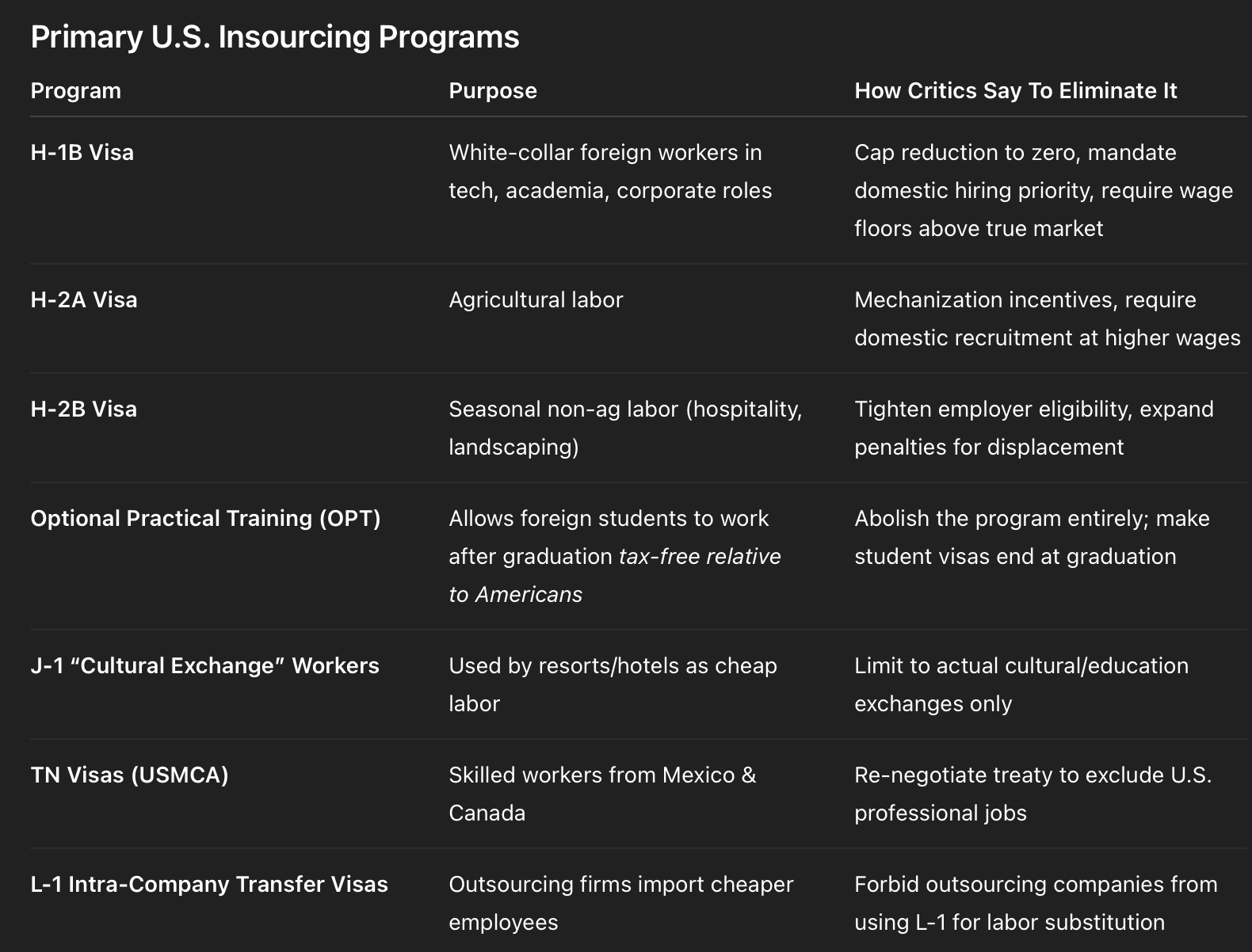
Today’s foreign-labor system is a sprawling jumble of visa categories, loopholes, carve-outs, and executive branch work-arounds. Each program was created for a narrow use case… and each has slowly expanded into a bypass of the traditional immigration process.
Critics want to abolish many of these programs. But ending them piecemeal won’t fix the structural chaos. The real solution is far simpler:
Put all foreign labor under one standard process, the employment-based green card system. Like it was always supposed to be.
Why? Because the green card route was originally designed to do what the labor system should do:
Prove the job is needed
Prove a qualified American is not available
Ensure wages meet U.S. market standards
Provide a stable, lawful long-term residency path
Everything else has become an ad-hoc workaround for employers who want speed, cost-savings, or loopholes.
Let’s break down why the current “insourcing” categories fail, and why consolidation benefits everyone.
H-1B Visa- A Temporary Fix That Became a Permanent Pipeline
Originally a short-term bridge for high-skilled roles, it has morphed into:
A wholesale replacement of U.S. STEM grads
A permission-slip for multinational outsourcing firms
A way to circumvent the more rigorous green-card labor certification process
If a job is necessary long-term?
Put it in the green-card queue.
H-2A & H-2B- Seasonal Programs Without Seasonal Oversight
These visas were sold as temporary boosts where labor shortages existed. Instead:
Wage suppression becomes state policy
Labor standards become optional
“Seasonal” workers become indispensable to year-round operations
If labor is truly seasonal, employers should prove it — and prove domestic recruitment failed — within the green-card pathway, not around it.
OPT (Optional Practical Training)- Work Authorization Without Public Consent
OPT was not created by an act of Congress.
It was created by regulatory fiat.
And its structure:
Lets employers avoid payroll taxes when hiring foreign graduates instead of Americans
Creates a shadow labor pool outside immigration law
Turns student visas into covert work visas
No country should have an immigration labor system based on bureaucratic improvisation.
Foreign graduates should convert into…
you guessed it: employment-based green cards.
J-1 Cultural Exchange & TN Visas- Mission-Creep Disguised as Diplomacy
What began as goodwill programs became:
Hospitality staffing pipelines
Quiet expansions in professional sectors
Legal “side doors” to avoid real vetting
Again: if it is real labor, it must go through a real labor process.
L-1 Intra-Company Transfers- The Insourcing Company’s Best Friend
This visa enables multinationals to:
Import cheaper internal labor
Displace Americans who trained their replacements
Extend “temporary” stays for as long as a decade
Temporary should mean temporary.
Permanent needs permanent residency rules.
Honorable Mentions: Other Carve-Outs That Undermine a Coherent Labor System
O-1B “Extraordinary Ability” Visas
Marketed as rare and elite, but in practice adjudicated subjectively and increasingly used as a speed-lane around labor certification. If talent is truly extraordinary and needed long-term, it should qualify directly through an employment-based green card, not a discretionary temporary visa.
E-3 (Australia) and H-1B1 (Singapore/Chile)
Nationality-based professional visas that bypass the main employment queue entirely. Labor markets do not change by passport. These programs add complexity without adding protection.
TN (NAFTA/USMCA) Professionals
A trade agreement turned into a standing professional labor channel with weak oversight. No labor test, no wage protections comparable to green cards, and renewable indefinitely.
CPT and STEM OPT Extensions
Academic authorizations quietly converted into long-term work programs. These operate outside immigration law, distort entry-level hiring, and allow firms to avoid payroll taxes and wage competition.
B-1 “In Lieu Of H-1B”
A technical loophole used to import foreign labor under visitor status. No labor certification, no wage enforcement, and minimal transparency.
H-4 EAD
Work authorization granted not for labor need, but as a patch to compensate for backlogged temporary visas. A symptom of system failure, not a solution.
EB-5 Investor Visa
Not a labor visa, but still relevant. It turns residency into a financial instrument and muddies the distinction between economic contribution and market labor need.
The Unifying Principle
Instead of regulating 8–10 separate immigration labor systems — each with their own loopholes — the U.S. should enforce a single model:
One pathway. One standard.
Proof of need → Labor-market test → Fair wages → Green card.
✔ Transparency
✔ Labor protection
✔ No displacement
✔ Integration into the American economy
✔ No more temporary-forever limbo
Conclusion: Green Cards; Can’t Justify One? Then You Don’t Need a Foreigner
The green-card system already contains the economic and ethical safeguards society expects; everything else is just a scam to get someone cheaper. They all need to go, and we need to return to Green Cards. If you can’t justify a Green Card, then why in the world do you need an overseas worker? Let’s be honest, before all of this fraud came out, no one even knew that wasn’t how it worked. America was doing way better before all this BUREAUCRATIC BULLSHIT. Outsourcing already struck a blow to America; there is no way this will be a positive, no matter how many times our tech giants simp for it. Now we do. End it all.
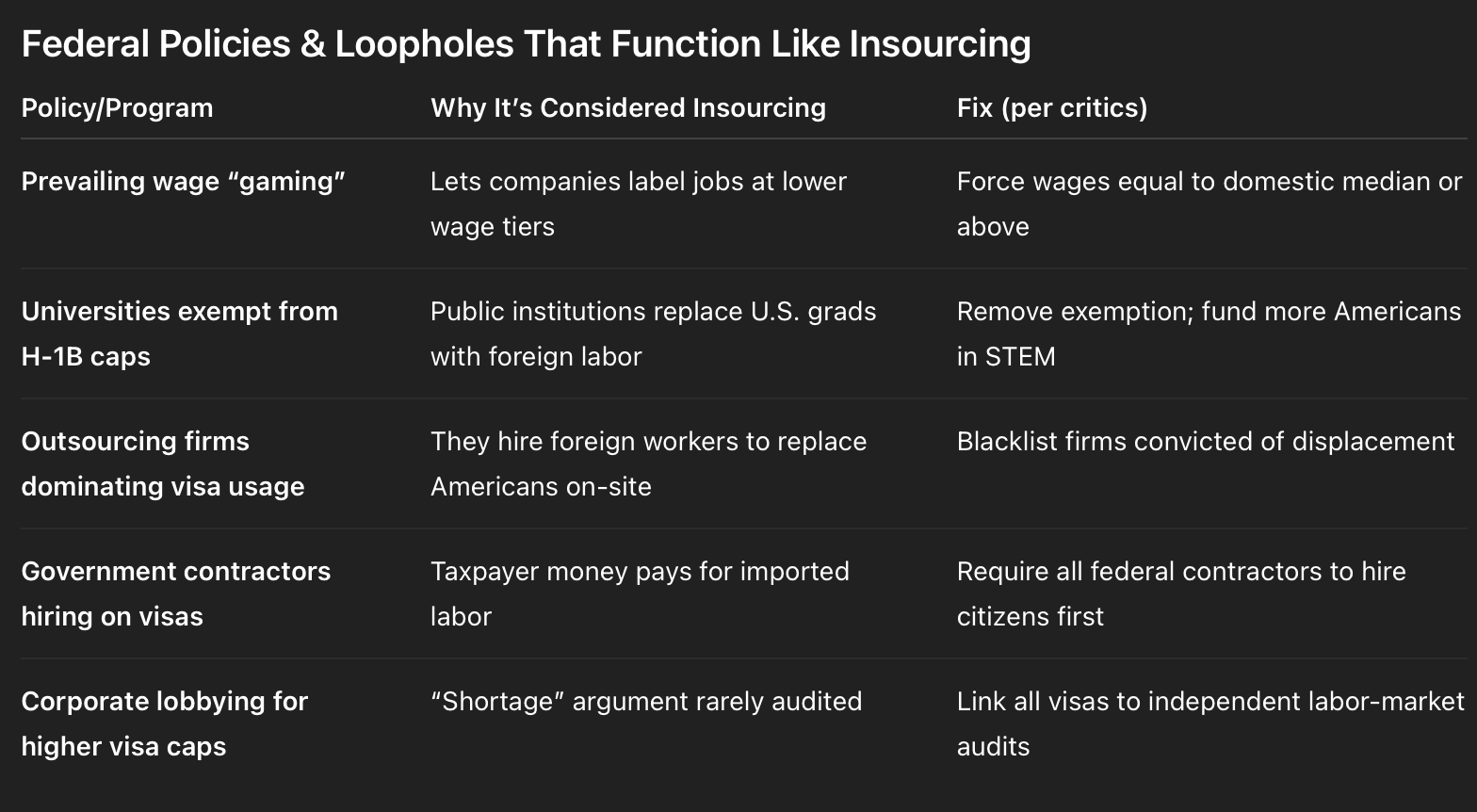
Your Future Depends on the Death of These Programs
Insourcing is a new level of evil. The enemies were at the gates selling your jobs to China. Now they’re selling your country to India. They hollowed out vast swathes of the Midwest, now known as the “Rust Belt”, this way. What do you think it will do to the entire country? Why would anyone want to call themselves Americans?
These middle managers are too removed from the effects of their decisions. You cannot trust that they will even think for a second about second, let alone third order effects on their own children from these betrayals. Your elite class think you are part of a global economy, the only problem being there are 2 billion Indians willing to come here to replace you. But you? Where can you go to build a better life? There is no where else to go, it is time to defend your homeland or have none. We have to end these programs, or we become a WEF Economic Zone.

Still shocking how much our own people are willing to sell us out.