

(Read part one here about fire, cameras, and automobiles)
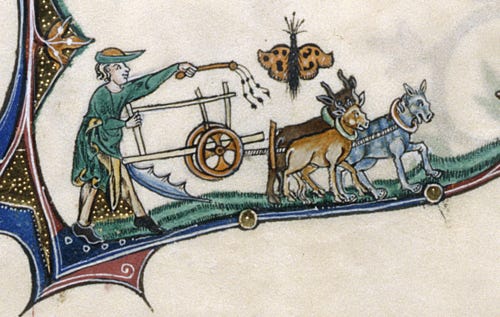
It is hard to say what is natural. Were we supposed to learn how to farm the land? Did we follow instructions etched in our brains? Was there one fate or another that was meant to unfold? Would certain stones have been better left unturned? And how fast do we adapt to our changing world to the point that we reflect it and seem like a natural fit for it, like we are abiding by some natural law, even though the environment and all its available tools may have changed at random through the wringer of time or due to a domino effect from a discovery like fire? Do we get back to our old ways? Get in touch with an earth to which we no longer belong? Return to a lifestyle to which our minds and bodies are no longer attuned? And at last, does innovation bring us closer to the human ideal or farther from it? In the age of artificial intelligence, these questions are impossible to ignore.
We begin to ponder and perhaps answer these questions by describing a few of the monumental innovations that were sprung upon us like a bolt of lightning, or constructed by us like a camera—those which punctuate and propel history as if they were meant to be. Like the turning points of a good story, innovations such as fire, the wheel, the camera, the steam engine, insulin, birth control, and electricity have altered how we think and how we define and resolve our human condition. They have sculpted human anatomy, its limits or lack thereof, nudging us almost unconsciously to take the next step through time, perhaps at their mercy, as we grasp at whatever tools are in front of us in a desperation to survive; if need be, we attempt miracles, try to turn water into wine, always evolving in tandem with an environment that never stays the same.
If the organism is the microcosm of the environment, as Richard Dawkins famously argued, then every part of us adapts to survive. But this is not necessarily in accordance with a “natural” law, nor does it progress us along a linear trajectory towards higher consciousness, because the environmental change that incites a biological change may appear to be by pure happenstance or by the doings of an “evil scientist” whose experiment gone wrong changed the course of history. Recall Chernobyl or, more personally, COVID-19. Religious, pagan, and tribal rituals like child sacrifice are also experiments gone wrong, but of a different sort because they require innovation of social organization and belief systems—engineering of ideas on God and the afterlife. Most of these superstitious practices have, however, fallen by the wayside because they have not withstood the rigours of science or the strictures of progressive moralism. Perhaps we can more easily jettison maladaptive ideas that risk the survival of the species compared to inventions that are not infanticidal per se, but stick around because of their great benefit. Alfred North Whitehead said that “the purpose of thinking is to let the ideas die instead of us dying.” The great impact of inventions like agriculture is that we cannot let it die, no matter how flawed it may be, lest we die along with it. Inventions outlast the ideas by which they were conceived in the same way buildings outlive engineers. But the spirit of invention, or more aptly, creation, may outlive everything.
Alcohol
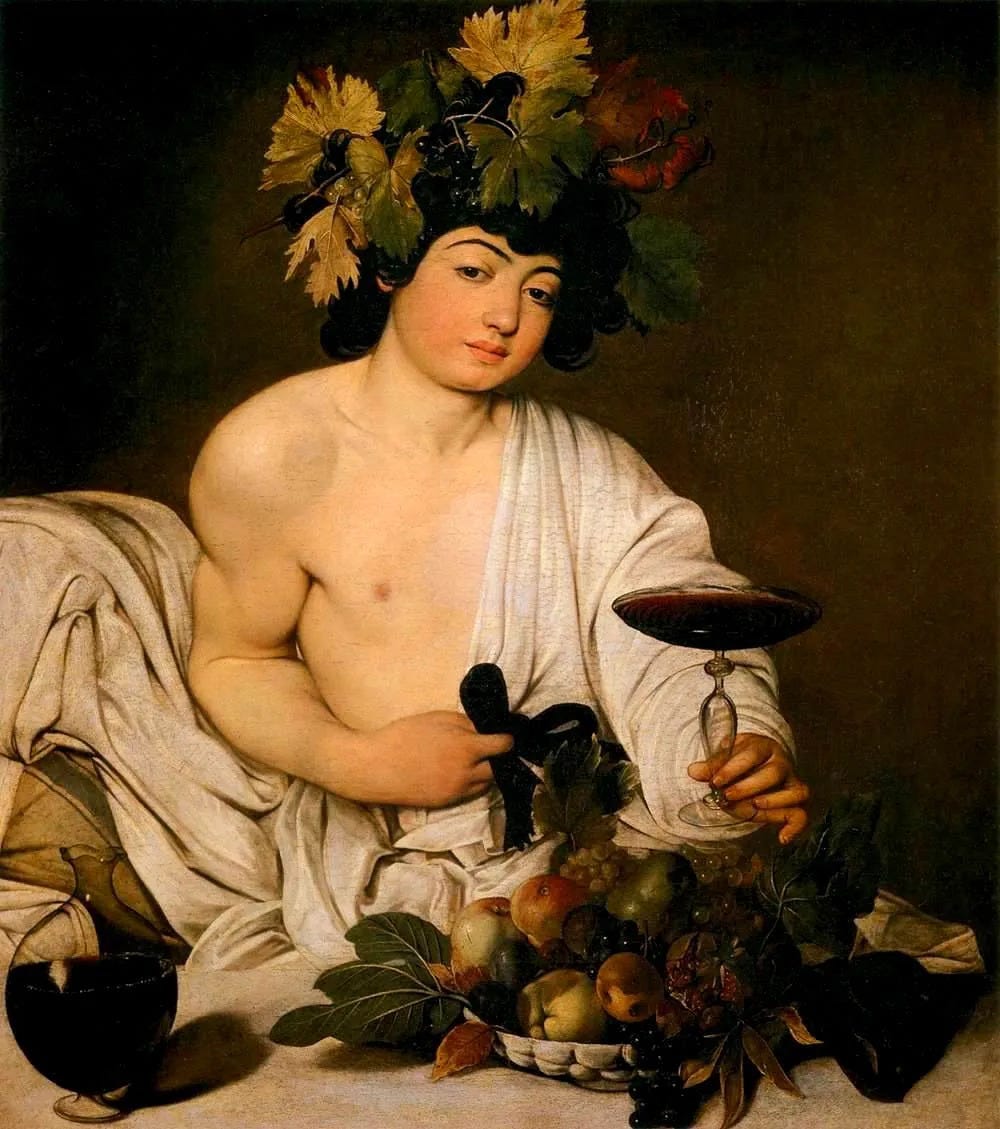
The story of how alcohol entered the picture of humanity is nothing short of incredible. 10 million years ago, our primate ancestors developed an enzyme to help digest fermented fruit which fell and sat on the ground. This primed us for a second event, which occurred 9.87 million years later, in 13,000 BC. Someone living in the Paleolithic era left a bit of wild grain, fruit, or honeycomb in a stone hollow, which is a divot in the rocky earth carved out with small, handheld stones. Imagine digging a private pothole to store your food in. This person forgot the food there; it sat for too long, and some rainwater mixed in. Then came the magic ingredient. The wind blew some yeast dust into the concoction. The mixture fermented. The next chap that came along tried it out and got drunk.
6000 years later, Neolithic humans had mastered this brew-making, turning an accident into a deliberate craft and serving it at ceremonies. Excavations in China revealed clay jars used to make alcohol alongside instruments like bone flutes that introduced music to the party. Archaeologists believe that alcohol was then viewed as a sacred substance; shamans consumed it to commune with dead ancestors’ spirits, and it was also buried with the dead. If I got drunk and, at the same time, my dead grandfather got drunk off the wine buried with him, perhaps we could meet each other in the spirit realm and have a conversation.
Over the 9000 years since the Neolithic Era, alcohol has played a similar role, honouring the dead with a toast, i.e., “pouring one out for the dead homie.” But it also galvanized armies, families, and kingdoms. A true “social lubricant,” alcohol has allowed us to adapt to levelling and mingling with outsiders and perhaps evolve to lean on, if not rely on, chemical disinhibition as a way to form bonds, unlock the libido, and encourage reproduction.
In 1943 and again in 1945, Churchill, Roosevelt, and Stalin met and mapped out the end of World War II while swilling brandy into the night. The “Whisky War” between Canada and Denmark, a dispute over the ownership of Hans Island, was settled because every time either side planted their flag, they left a bottle of booze—Canadian Club or Danish Schnapps—for their opponent to enjoy. The French liqueur ratafia was made for diplomats to ratify treaties.
Today, the alcohol industry is worth $2.7 trillion worldwide. Surveys indicate that people drink to socialize more easily, unwind, and enhance experiences such as dining or entertainment. It clearly serves a purpose. It is as if we have latched onto this thing, or it onto us, and we are bound together for better or worse, like a worm in that 10-million-year-old rotten fruit is still living in our brains. Where would we be without it? Has it done more harm than good?
Obviously, alcohol fuels destructive patterns. People can abuse it to cope with trauma, escape the day-to-day grind, or just because they have not found anything else they like quite as much. Alcohol is involved in 1 of 4 homicides in the US. But in moderation, alcohol has a lubricating effect that helped along the formation of societies. And if it wasn’t for alcohol, would we have simply picked a different poison?
It seems that fermentation was meant to find us, because it happens to fruit even without the accident of wild yeast blown into a puddle. Bacteria and wild yeast naturally exist on fruit surfaces. Yeast is like a parasite on fruit, relying on them for survival and co-evolution. Fruit flies assist in transporting yeast from its many hiding places in nature to the fruit, effectively pollinating it. The yeast then goes to war with the fruit’s other surface feeders, the bacteria and mould, and turns the fruit’s sugar into ethanol (alcohol), which then kills the bacteria and mould. Only the yeast can stomach the alcohol. Genius—it poisons its opponents and feeds itself in one fell swoop.
According to the “Drunken Monkey” hypothesis, proposed by UC Berkeley biologist Robert Dudley, the fermenting fruit our primate ancestors consumed 10 million years ago did more than give a buzz. For one, it caused a genetic mutation: the creation of the aforementioned enzyme called ADH4, which metabolizes alcohol and allowed us to consume fermented fruit without becoming a completely drunken prey for tigers to feast on. Secondly, the fermented fruit was a safety test; its distinct sweet smell signalled that its alcohol content had killed off the bacteria and mould, and the fruit was safe to eat, and better yet, contained more B vitamins and probiotics than fresh fruit.
With this co-evolution in mind, resting on fundamental laws of microbiology, alcohol seems less like an accident and more like an inevitability. If that is the case, then it is our duty to harness it as a tool for controlled recreation and ritual. We cannot behave like a ripe piece of fruit, a passive host for fermentation, or be the “Drunken Monkeys” that got picked off the jungle floor by hungry tigers.
These days, alcohol consumption is decreasing in Canada and the US at the hands of “healthmaxxing.” Psychologically, a neurotic and radical avoidance of unhealthy foods and substances can create health anxiety and make you a hypochondriac, because we can worry about every little thing that may impact sleep, energy, and overall well-being. If you feel that you are only as good as the fuel in your body, you reduce yourself to flesh and eliminate your will and your spirit. Feeling good or “clean” is about more than diet. There is more than a smidgen of moral purity projected onto the health and beauty industry, as if looking and feeling your best were enough to be good. I wrote about my own experience here. I concluded after three and a half years abstaining from alcohol that my deliberate aversion might have been doing more harm than good because it instilled a carefulness and an obsession with physical health that was worse than the hangover I was fearing. The more you ruminate on the resistance, the more power you give to the object of resistance. The more you rely on a feeling as a prerequisite to live your life, the more time you spend waiting and less time actually living.
We must have a conversation on the health of the soul and the spirit alongside this growing conversation on physical health. Because at the end of life, disregard for the physical body is a good thing for transitioning into the nonphysical. Our bodies will not last forever, so we ought to invest elsewhere, too. If a drink or two helps you make good memories, start lasting friendships, and get over your stage fright, then perhaps it was all worth the hangover.
Printing Press
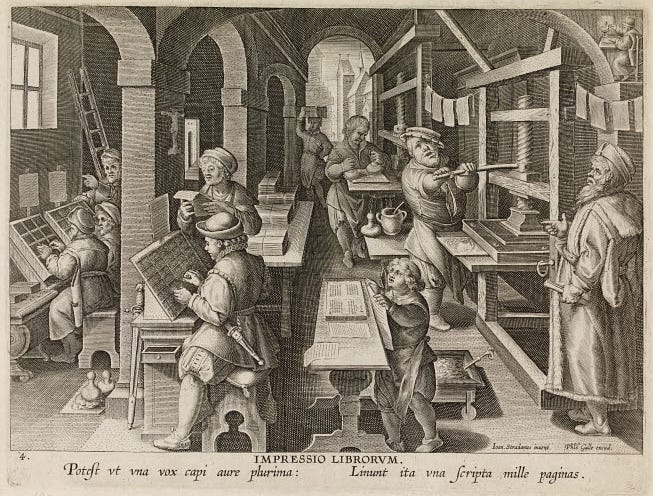
Before the year 1440 and Gutenberg’s invention of the printing press, most people were illiterate. There was no need to read, because there was not much to read. Scribes and manuscripts were rarities. Stories were passed down orally. The campfire, the tent, and the town square were hubs for the transmission of myths. This form of communication naturally invited discussion, planning, and group identification with stories. Reading a book, on the other hand, is largely a solitary experience. Proselytizing with a book, however, is a global phenomenon.