

Editorial note: Author Jake MacCallum is a psychiatric care worker, elementary school educator, and master’s student from the East Coast of Canada. He writes about Jungian psychology and the evolution of beliefs.
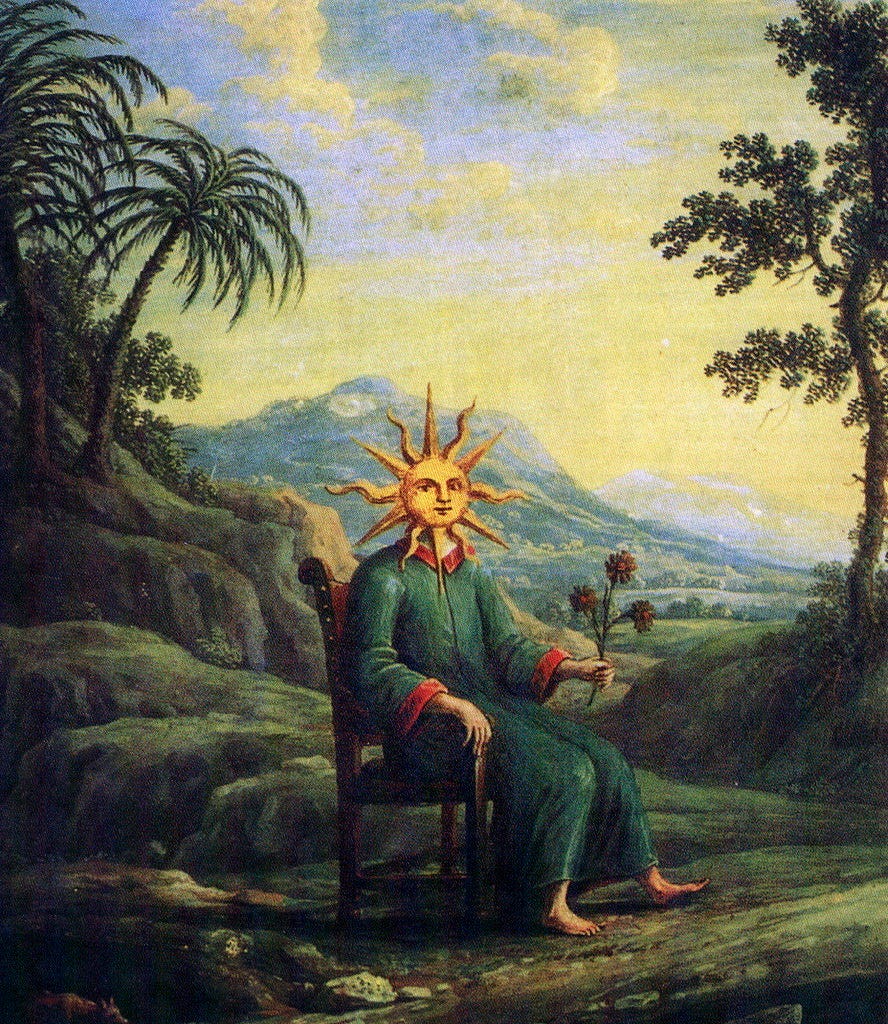
Pneuma is an ancient Greek word that means “breath,” and it signifies the animating spirit within the human being. Some call it the soul, the Holy Spirit, or the “breath of God.”
Pneuma, or the soul, is what sets psychology apart from the natural sciences and blurs it with religion, philosophy, and myth. This hard-to-explain mystique of the soul has created a void of information and caused the field of psychology to struggle for promotion from pseudoscientific status while in recovery from the reputational damage caused by pop psychology, insane asylums, appropriation by dictators and marketers, and the cringeworthiness of modern-day therapy speak.
But just because the question of the soul and its lack of clear, scientific evidence for existing has produced many failed and fatal attempts to define it, or lack thereof, does not mean that we should do away with the mission altogether; because the idea of pneuma also serves as a point of entry into illuminating the conversation on abnormal psychology and the ethics around assessing mental illness relative to history’s shared understanding of the human experience. “We all breathe the same air.”
It is necessary to point out that the natural sciences are not purely objective enterprises to begin with, as scientists are not immune to the elements of their inspection. Gravity, meiosis, and entropy frequently puppeteer the personality. But psychiatry is the least objective of the bunch because the student is precisely the study, the scientist the science.
Beliefs about everything—the Self, the sanctity of life, individual sovereignty, our place in and importance to the universe, the capacity for healing and transformation—all bleed into psychology more abruptly and permanently than other disciplines. How to treat a person in a psychiatric ward is perhaps a more complex or at least more immediate question of ethics than how to treat a culture of moss in a petri dish. But we are wired to confront and answer such questions, and so we should not shy away from the ontological, cosmic, and moral realities that are part and parcel of healing others and creating harmony. Psychiatry is the group project of humanity.
Psychiatry does not benefit from the illusory separation between the subject and object and the somewhat detached curiosity that attracts investors to the “Give me the data” business. In psychiatry/psychology, there is no true blind study, no partition of impartiality, no crystal clear magnifying glass. Instead, the view is obscured through a kaleidoscope and doubled by a mirror.
The psychological theorist is not aloof or impervious to the theory of his mind, the theory from his mind. Every step, every advancement into the field of study is an advancement into the far reaches of his soul. Findings, therefore, can easily become skewed, either minimized or exaggerated, by the researcher’s ego-defensiveness, as if to say, “I cannot imagine myself the same species. That phenomenon is either so small it’s benign or so big it’s alien. But whatever it is, it is definitely not me.”
Psychology thus necessitates introspection for its teachers and learners to cope with and later embrace the dilemma of seeing themselves most viscerally reflected in their work. But this realization of nonduality should not only humble the heart; it should rebound outwards to others and constitute a moral philosophy of “I am you, and you are me,” that protects psychiatric patients, so that they may be treated with the same dignity as their doctors, imploring the latter to see the patient in themselves, deepening their capacity to acknowledge the One in the many, and the many in the One.
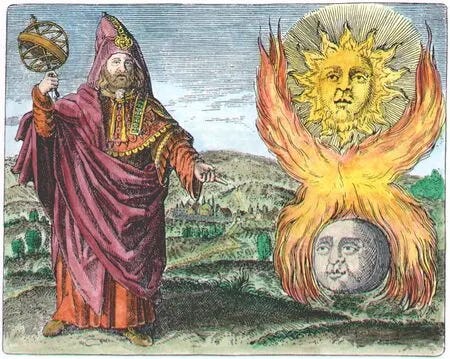
Reflected in every mental illness is the potential for all conscious energy in the universe to copy it, to repeat it. If only the psychologist were a bit bolder to venture further into such metaphysics of the soul, he might believe each person to be a fellow extension and avatar of Creation. Truly, only then would the fate of his patients become his responsibility, and diagnoses would be made in the spirit of self-understanding, not alienation or mechanization, as if to say, “Yes, I can handle looking at that ugly side of Creation and therefore of myself. I accept that we are cut from the same cloth.”
We may recall Terrence, the Roman playwright—“Nothing human is alien to me,” and reimagine that “No mental illness is foreign to my mind.” For nearly every potential destiny and form that can be conjured in imagination was first endorsed by Creation, once manifested in dream, then myth, then reality, and the pattern continues. The connective tissue of time expands and contracts with the breath and behaviour of its inhabitants. Wrongdoing and malformities, blindness and lies, are no exception. They are products of biodiversity or universal delusions.
And in light of such abnormalities and errors, note that we have all been at the mercy of and later a witness to the folly of an infant brain and the helpless outbursts it channels into his or her little body. Small wonder how some adults are, at times, only capable of the same, regressed level of rationale and primal emotion.
“Nothing new under the sun,” wrote King Solomon to describe the cycles of history, which also, as I argue, continue to repeat within the modern mind over a lifetime. That is why psychology would do well to incorporate a history of the soul as storied in myth. Presently, it too often pathologizes what it cuts out from its narrow view of being human.
For example, take a patient obsessed with collecting and caring for rocks as if they were pets. You might believe him to be unique and even alien-like in this obsession unless you were familiar with the myth of such-and-such people who spent generations venerating stones of all kinds as tools and totems of protection, preparers of food, and keepers of magical wisdom. Similarly, the hysterical or catatonic woman of the day appears the first of her kind—crazy—until one learns of the Oracle of Delphi and Medusa and then begins to see the redemptive power behind her tragedy, the lunar design underneath her so-called lunacy. The priestess does not exactly flourish in a mental hospital, and she is hardly recognizable in the blue gown there.
See, it is not only that these mental conditions are internally and universally possible and historically and mythically catalogued, but that they are perhaps the intimations of a transformation of the utmost risk and reward. Carl Jung echoed the alchemical motif, “In filth it is found.” Joseph Campbell also depicted this paradox of wisdom submerged in or emerging from darkness below. “The psychotic,” he wrote, “drowns in the same waters in which the mystic swims with delight.”
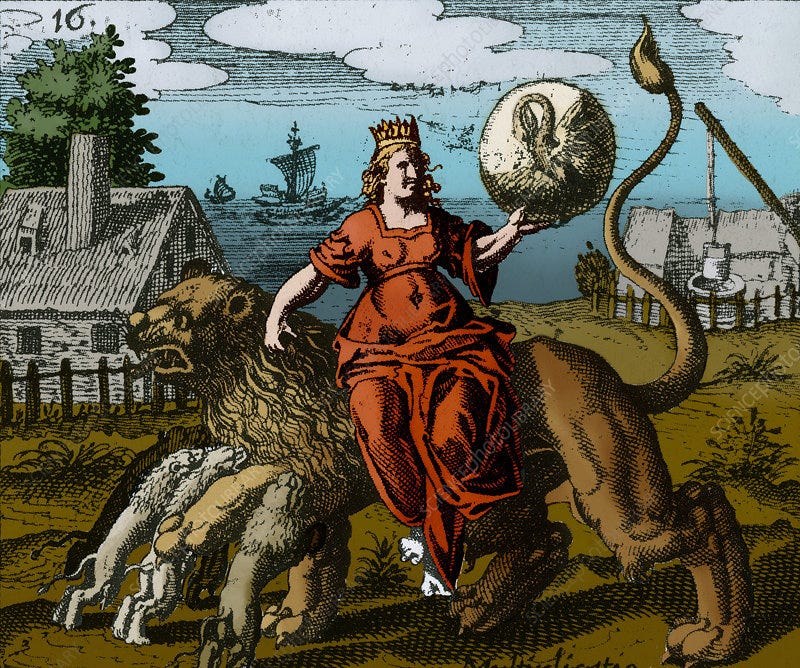
A man crippled with existential dread might strike the ordinary person as wimpish, but this man may have been staring into the proverbial abyss for a decade. He has accepted and borne the weight of the universe on his shoulders. But he suffers because he has taken on too much, too fast. He must absorb life incrementally and with adequate insulation between him and the omnipotent aura of the Divine. Bring to mind that Moses could not withstand looking at God in totality; just a glimpse of God’s back was enough to make his face radiate forever. God’s instruction to Moses was to avoid looking at His face, for anyone who did was sure to die.
To be a protective buffer, then, is the purpose of the wizard who initiates and guides the hero into the underworld. The blessing received from a maternal conduit of Creation before one journeys down into the shadowy canyon is like the protective shell of an egg. And it is the defensive ego, the outer mask, that pulls the dreamer back into a wakeful state of awareness and personalized integration and saves her from the devouring unconscious and indifference to life. “Beware of unearned wisdom,” Jung wrote.
Otherwise, the existentialist decides to fight monsters on his own, unprepared and unaccompanied, and he may become a monster himself in the process of survival, as Nietzsche described. Picture the drug addicts whose pre-emptive and unpredictable emotional defence systems, as well as their bodies, have adapted to reflect the terrain of their highs and lows, like a frog whose speckled backside indicates the flora of the deep, its lengthy tongue the flight of its prey.
If not careful, one can be poisoned by the overwhelming, borderless realm of consciousness or burned by playing with the fire of Being. But a little of the poison that kills you, cures you. “Only the dose makes the poison.”
Those in contact with the otherworldly might appear independently insane, but in truth, they are communing with the collective unconscious and may only lack the ego strength—the insulating, buffering shield—that is supposed to bring them back in one piece from their dreamlike/nightmarish state.
Finally, all the experiences detailed in mythology and religious stories, even modern fiction, interpreted as a metaphor for the psychological realm, become a storehouse of reference points for apparent anomaly, bringing the famous exemplars of antiquity into sublime unity with the mysterious archetypes embodied by the modern-day psychiatric patient. Frodo Baggins, for instance, had to lose his mind to the unbridled power of the ring, confront the shadows of Mordor, and face the fact of his physical limitations before he became the hero and liberator of his soul.
If you think of yourself as only a brain, then so be it. Chemistry will cover that. But if you are a soul, and you believe that, then through the ways of the soul should you be healed, and by the breath of God will you know.
I thought this very good, and a handy tought tool for considering the eccentric and mentally ill.