In psychotherapy, rarely is the presenting problem the core one. We eventually get to the bottom of things to see what uglier thing the surface problem was opaquely reflecting. The same is usually true for everyday problems.

“We suffer more often in imagination than in reality,” Seneca said. But this suffering can double back into reality as it stretches outside of imagination and into the social world via a psychological mechanism called projection. We project onto others our past and present fears and desires, effectively morphing them into playthings against which we test what we wish to gain, prove, or protect. We might mask feelings of attraction toward somebody by being cold or disguise hatred in the clothes of the overly nice. We might try to get even with the world because we feel treated unfairly by our minds. We might talk too much to get the attention we never had. This uncontrolled word vomit repulses most listeners, driving them away. But we can become aware of these habits of the unconscious and do something about it.
Small talk is an easy-to-understand example of a more acceptable kind of social projection. Small talk is not about what you are saying as much as why you chose to say one thing over another and how you say it. It’s not about the text as much as the subtext. Form over content. It doesn’t say, “Rainy day, huh?” as much as it invites your interlocutor to elaborate about his day, his view on bad weather, or a story about his morning traveling through it. It is a chance for him to present himself for you to “get a read on” his tone, posture, eye contact, trustworthiness, and willingness to continue the conversation. It is usually just a polite gesture to allow someone else to speak. In the subtext, it says, “I am willing to talk if you are.”
Your friends, as good metrics of your receptivity to emotional closeness, represent more than just who they are; they represent what they mean to you, essentially reflecting who you are. But people do not like that responsibility to manage someone else’s emotions all the time, and so it is an individual responsibility to become conscious of otherwise unconscious projections. If not, the following unconscious script plays with a theme of underlying pain and a subsequent need for consolation.
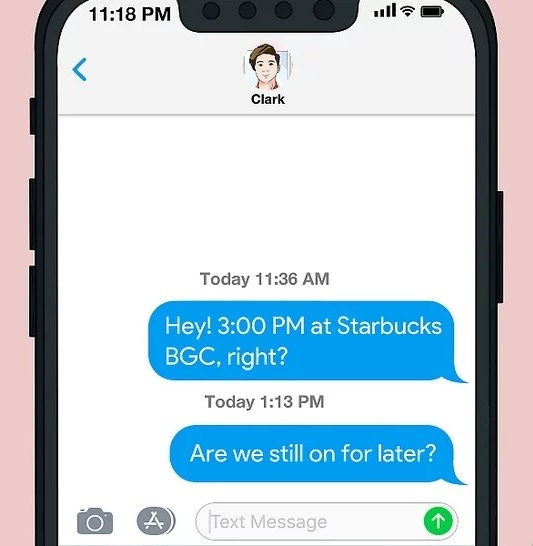
You don’t get a text back from your friend, and something about it bothers you. The thing is not simply that your friend has not texted you back or that you will feel better by counter-ghosting or double-texting. It’s that you feel rejected by someone who holds the key to your wish for a reply, your wish to be heard. Perhaps an inferiority complex comes online, the one that was conditioned years ago by a parent or a bully or a bout of depression. The memories of being rejected by a previous friend, a coach, a sibling, or a debutante. Maybe you were abandoned by your parents. You could call this a trigger, but often the connection is not so clear. All you feel are the immediate emotions, the hurt, the anger, the sadness, and it is not so obvious why they feel all too familiar.
Because your friend is human, he or she also represents a part of you, a potentiality of your shared humanness, and that reflection of yourself seems at odds with the rest of you when it goes cold. You wonder how someone could be like that. Could you be like that? Your distant friend might symbolize the voice in your head that keeps saying, “You are not good enough,” or “You can never get what you want.” You project onto your friend your wish for closeness, love, and acceptance, and your friend is doing the same, and is perhaps replaying the broken-down dynamics he or she had with a sibling. Your friend might ignore you in an effort to settle an internal conflict or grudge he or she holds against a brother or sister, fulfilling the desire to make peace or level the score with an internal framework for a fraternity or sorority. Or the silent treatment is a rebellion against the fact that your friend grew up under a strict demand to answer to mom and dad. Together, we make up for the lack but perpetuate the pain.
Freud called this “Wunscherfüllung” — wish fulfillment. And he defined it in true atheist, neo-Lamarckist fashion, prioritizing procreation and the basic need for safety and satiation. He believed our unconscious drives and inherited primal memories steered the ship, and our behaviour was a manifestation of repressed wishes or half-baked resolutions to unresolved developmental conflicts between two or more wishes. A fellow atheist (at least by conventional religious standards), Ludwig Feuerbach, of whom Freud was a disciple, pioneered this idea of wish fulfillment not in psychoanalytical terms but in the religious, claiming our personification of God was only a projection of human ideals made separate and yearned to be reunited with. Feuerbach believed that by worshiping God, humans were making themselves aliens from their own true nature. This version of wish fulfillment also incorporates how we project comfort to treat fear, as in creating a story of the afterlife to pacify death anxiety.
So if much of what we hold as truth is merely a wish fulfillment, a projection of what we wish/fear were true, or at least a behavioural effort to consciously or unconsciously act out that wish, then how do we step back to tell truth from falsehood?
Jung said that we must make conscious the unconscious lest it dictate our lives and we stupidly call it fate. I think he was right. And what illuminates the shadows of the unconscious other than the shining ego? Ego in the Freudian/Jungian sense, more akin to personality than the persona or mask, which has less favourable connotations in spirituality, i.e. ego death. It’s strength of character, in other words, that splits wheat from chaff, that has the humility to accept lack of control and then the bravery to exercise more of it.
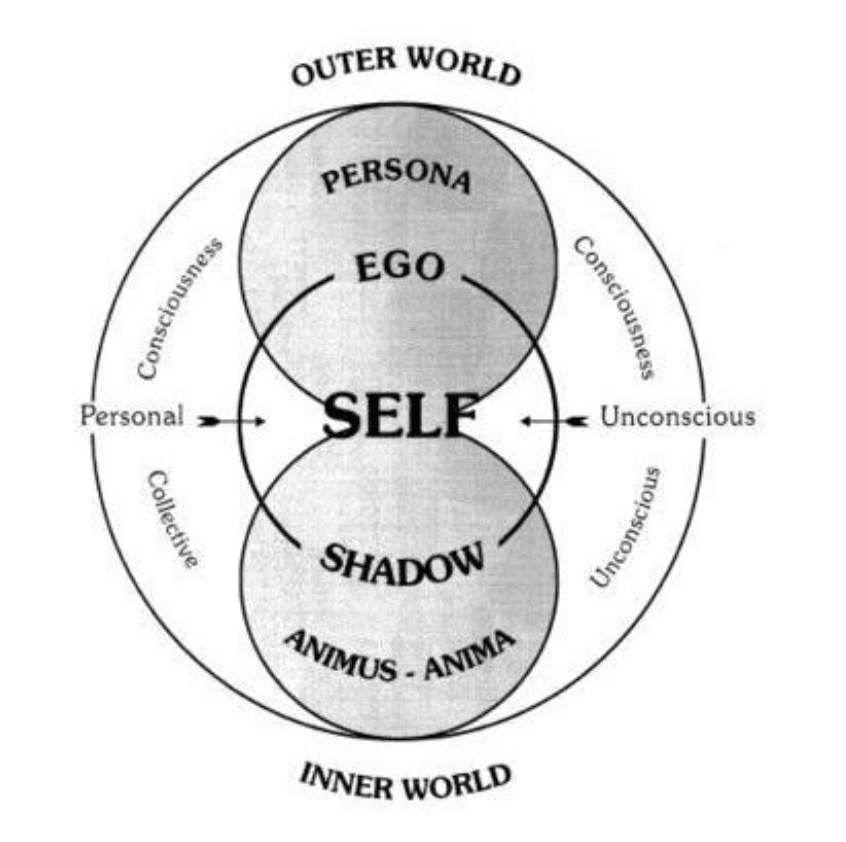
Marie-Louise von Franz was one of Jung’s star pupils, and she believed a man who lacked ego strength would succumb to a dreamlike state. He would see every woman as an idealized projection of his anima—the feminine portion of his psyche. In every woman, he sees the purest princess. He sees his future, his completion, his missing link, and his validation. He sees an amalgamation of his ideals. To him, she is everything but human. This causes many relationship troubles via the archetype of the simp man.
This lethargic, egoless man struggles to get out of bed after a night of intoxicatingly lucid dreams, hungover on the symbols and images of his unconscious. If he stays in the dream, he is like the hero who does not make it back from the underworld, who falls in love with the ring of power or falls asleep to the song of the sirens. It takes the heroic stance of the ego toward your unconscious to return to the real world with an integrated and sublimated shadow.
The ego is the buoy to tie a line to when you plunge into the overwhelmingly deep swamp. But there is little language for this in modern times, and so more people than necessary suffer from the projections of wish fulfillment due to misunderstanding an unbridled unconscious. Modern psychology is lost on the hyper-rational bourgeois because it often bleeds into mystical questions of the divine. It straddles the border between science and art, blurring more than it clarifies. It writes in math but speaks in tongues.
Psychology has failed to fill the proverbial God-shaped hole because it does not provide the same placation of fear as religion, even though it aims to explain similar mysteries about the nature of the human soul. Olden times had religion and myth to elucidate the unconscious, the hidden desires of the heart, and the duties of the hero on the metaphorical journeys into the deep. There was a confession of identification with the heroes and villains of the great stories of time, whether Biblical, mythical, or local. Psychology lacks the element of a good story for people to adequately understand it, understand their unconscious, and therefore, we have mass blindness forming a mental health crisis.
In Japan, there is a saying, “Tōdaishita no mottomo kurai”— it is darkest under the lighthouse. Despite the outward, scientific attention paid to the natural and supernatural worlds, from ocean to sky, our blind spots are nearest to us, within us. It is said that we know more about space than about our oceans, more about what is out there than what is in here.

The problem is that the word ego triggers people. They think of Trump or of their cocky hockey coach. They think of a big head or an “I’m-better-than-you” attitude. They do not think of ego in the Jungian sense of the word, which is the key to protecting yourself against unconscious wish fulfillment, and the apathy and nihilism that come from lack of heroic ambition. Jung believed the ego was necessary to insulate oneself from the devouring abyss of the unconscious and to survive the journey between it and reality. It served the purpose of realizing the true Self (Self is capitalized to signify Jung’s Gnostic belief that God is realized through the individual—the One in the many and the many in the One). Ego is less inflation and more frame and containment.
A healthy ego is secure in its ability to wage and manage the civil war before it becomes a world war. It can prevent the social and emotional damages detailed earlier by turning inward and transforming.
“The first half of life is devoted to forming a healthy ego; the second half is going inward and letting go of it,” Jung said. He also warned against letting the ego take full control over the flow from unconsciousness to consciousness: “An inflated consciousness is always egocentric and conscious of nothing but its own existence.”
In short, Jung was not advocating for egocentrism but ego development. And later, its release in time for physical death. You have to play your role while you still have your name. Soon your spirit will be released, but for now it is encased in a fleshy vessel with unique skills and traits. Use it before you lose it. That would be my interpretation of Jung’s advice for a healthy ego, but there is a lot more to this process of becoming yourself, which he called “individuation.”
So socially and romantically, it is important to understand what you are really up to, for your left hand to know what your right hand is doing. Is some unconscious script unfolding outside your awareness? Are you trying to use somebody to patch your wounds? Are you fighting your own demon by casting its image on the faces of so-called enemies? Are you falling for the wrong person because you are lovesick on the projection of your own dreamlike anima/animus? Are you actually seeking psychic wholeness when you have physical union with the opposite sex? And if you really believe that you have a soul, what does it want? To escape? To be held? To speak? What does your soul want to go? Who do you let it follow?