


Editorial Note: This essay is the first of five in which we do a “deep dive” uncovering what we believe to be the factors at play that influenced the Council on Social Work Education’s (CSWE) strong ideological bent, notably from 2020 onward.
UPDATE: As of 2/10/26, this essay has been lightly edited to include archived links after learning that several original CSWE links are now broken.
The Two Pandemics
In June 2020, Saundra Starks, the Council on Social Work Education’s (CSWE) Chair of the Board of Directors recorded a video message to the country’s graduating class of social work students. She spoke as one of two elected leaders for the CSWE, the field’s national accrediting body and overseer of professional education programs that feed into the largest group of mental health professionals across the United States:
She invoked simplistic, yet prejudicial assumptions drawn from so-called progressive values and identity politics. “This season,” she added, “the wounds are publicly exposed, revealing these disparities based on the color of skin and on anything different than the privileged: White, Christian, heterosexual, and male.”
Starks, eager to transform professional social work education into activist education, swiftly collaborated with Darla Coffey, the CSWE’s then-President and Executive Director, and by August 2020 the pair formed the Task Force to Advance Anti-Racism (the reader will note the perspicacious Kendi quote headlining the top of this document). In her June message, Starks had made a moral pledge to students, promising “changes in our curriculum, the way we teach, that can earnestly promote the dismantling of white supremacy, patriarchy, income inequities, and systems of oppression.”
This politicized pledge resulted in more than just words. In November 2025, the CSWE supported the actions of Jessica Adams, a social work professor from Indiana University (IU) who lectured, without counter-perspectives, about the “pyramid of White supremacy.” Adams was suspended—later reinstated in December—after a student raised a formal complaint under the state’s 2024 intellectual diversity law. (The ideologically slanted origin of the pyramid is from a 2005 “Tools for Liberation Packet” from the Safehouse Progressive Alliance for Nonviolence.)
As it turns out, the CSWE’s latest backing of politically one-sided education in the name of program “autonomy” was a long time coming. This essay and subsequent ones will mirror some parallels to what’s happened in other disciplines, including neuropsychology, counseling, and psychology, among others.
Convening the Task Force
We reviewed publicly available documents—committee reports, news bulletins, conference presentations, policy documents—from the CSWE’s website that show how, starting in Fall 2020, Starks and Coffey’s joint decision to launch the anti-racist Task Force bent the entire U.S. social work accreditation apparatus towards a forced progressive, DEI-infused perspective on steroids.
At the time, the CSWE was three years into a five-year process of revising its national curriculum and policy standards, known within social work higher education as the Educational and Policy Accreditation Standards (EPAS). Last released in 2015, the EPAS gets revised every seven years in accordance with the CSWE’s Accreditation Policy Handbook. Both the 2015 version and 2022 version of the EPAS claim that accreditation “entitles [institutions and programs] the confidence of the educational community and the public they serve.”
Starks and Coffey, in preparation for the 2022 EPAS, assembled the Task Force with four Work Groups, directing each Group to come up with anti-racist recommendations and a corresponding action plan. Work Groups focused on four areas of social work education: curriculum development, educational policy and accreditation, faculty and student racial/ethnic equity, and conferences and faculty development.
Starks and Coffey also endowed the Task Force with an outsized influence to shape the future of professional education. The consequence, as we learned, was an intentional infusion of a racial justice- and equity-obsessed ethos throughout the country’s 900+ Bachelor’s and Master’s-level programs, a move with undoubted ripple effects on newcomers joining the profession’s 800,000+ practitioners throughout the United States.
These developments not only raise crucial questions about the concentration of unaccountable power within the social work education bureaucracy but also throw into question the credibility of an accreditation process that claims to work on behalf of a politically diverse American public, even as leaders sneakily injected a deeply unpopular and controversial ideology.
Recommendations & the 2020 Annual Program Meeting
Later, at CSWE’s online November 2020 Annual Program Meeting, the Task Force presented preliminary recommendations to saturate social work education with anti-racist ideas. Ibram X. Kendi, famed for his shallow promotion of anti-racism, gave the plenary lecture at the Meeting, telling educators, “All we can do is ensure we are teaching and executing an antiracist curriculum.” Dexter Voisin, Professor at University of Toronto’s Factor-Inwentash, concurred, condemning in illustrative prose one racial group in particular: “So at times, we all falter when we need to act. We fail to do the painful but necessary work of peeling back the deep insidious layers of white supremacy that spins this web around us all from the cradle until we are laid to rest.”
The Task Force’s presentations tell their own story of ideological capture. Beneath their aspirational language “to make social work education stronger,” the four Work Groups explicitly sought to push professional education further into far-left radical territory and unmoor standards from the diversity of political values in the American populace—including within different racial groups. (The Journal of Free Black Thought, for example, opines, “Black thought varies as widely as black individuals.)
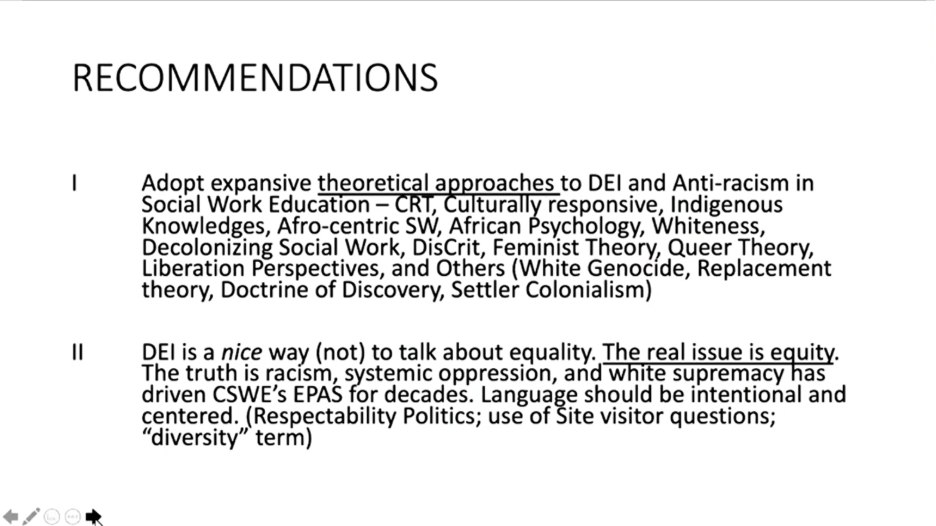
Rebecca Moore, Co-Chair of the Educational Policy and Accreditation Work Group, reviewed her Group’s set of ideologically slanted recommendations for the 2022 EPAS (see below screenshot).
Yarneccia Dyson, Co-Chair of the Curriculum Development Work Group, explained the need to inject ideological education by force. “[We talked about] the importance of getting away from language that’s passive, like programs should do this or programs can possibly do this to mandating programs to enact change so that anti-racism [sic] goes away.”
The Task Force appeared to get what they asked for. The CSWE approved the final EPAS version in June 2022, with revised policies and standards mandating Anti-Racism, Diversity, Equity, and Inclusion (ADEI).
Today, the American public has little reason to believe this type of ideologically slanted education is going away. The Indiana chapter of the National Association of Social Workers (NASW), the field’s main professional organization, joined the CSWE in defending the suspended IU professor last November. “Not only was Ms. Adams teaching an approved curriculum as part of an accredited social work program,” the NASW reasoned, “but she was training the next generation of behavioral health professionals.” In other words, the professor’s teachings were entirely justified by the ADEI Trojan Horse the CSWE stealthily injected into social work education writ large.

Nathan Gallo, MSW, CNA is a recent Master of Social Work graduate and hospital nursing assistant based in Northern Colorado. He has written about the importance of cognitive liberty, tolerance and value pluralism in social work education. Gallo also led a case study article on medical aid in dying (MAID) and motor neuron disease, published in the flagship journal for this practice, The Journal of Aid-in-Dying Medicine.
Arnoldo Cantú, LCSW is a clinical social worker and psychotherapist with experience in school social work, private practice, community mental health, and primary care behavioral health seeing children, adolescents, families, and adults. Cantú was born in Mexico and considers Texas home having grown up in the Rio Grande Valley, though currently resides in the beautiful city of Fort Collins located in northern Colorado. He has been the lead and co-editor of several volumes in the Ethics International Press Critical Psychology and Critical Psychiatry Series. He's written critically not only about the idea of so-called mental disorder, but also the idea of race categories.
No one EVER asks them "What can I as a white person do in the US, that you cannot do? One single example"
They cannot answer this question because there's not a single thing. The Constitution they aim to destroy actually ensures THAT.
Social Work bureaucrats are zealots.