


Editorial Note: This essay is the second of five in which we do a “deep dive” uncovering what we believe to be the factors at play that influenced the Council on Social Work Education’s (CSWE) strong ideological bent, notably from 2020 onward. View the first essay here.
UPDATE: As of 2/10/26, this essay has been lightly edited to include archived links after learning that several original CSWE links are now broken.
A Questionable Footprint
Sometimes establishing a legacy within one’s profession leaves its institutional foundations worse, not better. In December 2022, Darla Spence Coffey left her own politicized legacy on social work education, retiring (after enjoying a hefty salary of over $300,000) as President and CEO of the non-profit Council on Social Work Education (CSWE), the sole national accrediting body for one of the fastest growing professions in the United States. “In the past year,” the CSWE’s 2022 Annual Report proclaims, “[Coffey] has been laser-focused on advancing social work education that is decisively anti-racist, anti-oppressive, and decolonizing.”

We previously wrote about Coffey, her colleague Saundra Starks, and their outsized ideological impact—including a top-down decision to launch the Task Force to Advance Anti-Racism—on the direction of national social work education. Here, we continue the investigation, using publicly available documents from 2018 to 2022 to illuminate how the organization mandated anti-racism, diversity, equity, and inclusion (ADEI) “approaches” into Bachelor’s, Master’s, and now practice Doctorate-level programs.
Indeed, the rollout of these ideological mandates in June 2022 has, in our view, birthed a lost generation of social work practitioners, mental health professionals, and researchers. These mandates also created an illiberal permission structure that led to a September 2025 race- and sex-based discrimination complaint with the Department of Education’s Office of Civil Rights (OCR), where an undergraduate student in Colorado State University’s social work program confessed, “I don’t feel safe in this classroom.”
What’s more, this permission structure seemingly emboldened an instructor in that classroom (named in the same complaint) to proudly publish about disregarding and laughing at “the white dudes in class.”

Developing the Standards
Today, the source of social work education’s waywardness throughout 900+ U.S. programs comes from revisions made to the CSWE’s Educational and Policy Accreditation Standards (EPAS), enacted by the organization every seven years. These are a set of compelled standards upon which social work programs’ accreditation statuses are predicated, as forcefully described in an October 2025 presentation by the CSWE: “2022 EPAS Assessment Essentials: Compliance as a Compass to Accreditation.”
According to a 2022 EPAS development timeline (see screenshot below), the CSWE was primed early to pivot towards what we discerned as a DEI-infused perspective “on steroids.” Between 2018 and 2019, the organization completed an environmental scan—feedback from who is unclear—and definitively prioritized “diversity, equity, and inclusion” in preparation for the next EPAS revision.
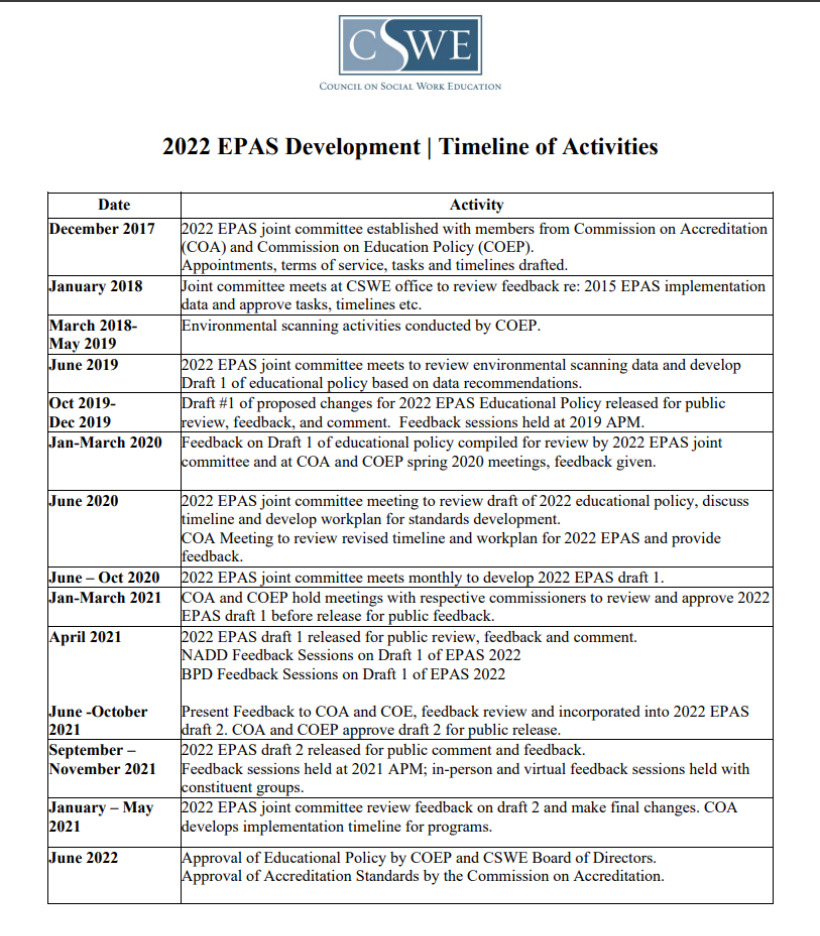
In June 2019, a Joint Committee within the CSWE—consisting of the Commission on Accreditation (COA) and Commission on Education Policy (COEP) —completed a first internal draft of the EPAS and worked on the document through mid-2020. As we reported, Coffey and Starks reacted institutionally to demands for “racial justice” by establishing the Anti-Racist Task Force in August.
In September 2020, the CSWE clarified the Task Force’s role in driving the 2022 EPAS revision process, envisioning a singular mission for new social workers entering the profession that centered on “racial equity.” Recommendations from the Task Force, a news bulletin explains, “serve as a starting point to ensure that the 47,000 social workers who enter the workforce each year are ready to champion social justice causes.”
Concurrently, social work’s current professional Code of Ethics, produced by the National Association of Social Work (NASW), indeed upholds social justice in addition to five other professional values—service, dignity and worth of the person, importance of human relationships, integrity, and competence. However, these values and a focus on professional skill-building were effectively ignored as the Task Force substituted a balanced vision of social work practice with its preferred, ideologically closed version of what scholars label as “critical social justice.”
In February 2021, another news bulletin indicated that the Task Force “continues to refine recommendations that intentionally work toward a more antiracist vision of social work education,” realized through top-down curricular changes throughout the 2022 EPAS. A first draft became available for public feedback on April 6, 2021, soliciting comments from educators by survey.
Ignoring Feedback
Debra McPhee, Chair of the COEP, described the CSWE’s chase for importance, explaining that the priority “[has] really been to make sure that this next EPAS is relevant to a changing world and really serve programs for the remainder of the decade.” Deana Morrow, Chair of the COA, specifically praised the Task Force’s ideology:
“We really want to thank the CSWE Task Force, the Anti-Racism Task Force, because their work, their rapid and in-depth work, has really been helpful in informing us in really trying to weave ADEI across all of the 2022 EPAS.”
In September 2021, the CSWE released a summary of survey feedback after receiving written responses from 564 social work educators (in addition to feedback solicited at two conferences and a town hall event). Even within the small sample size (current social work professionals total over 700,000 while faculty total an estimated 11,500), respondents raised concerns about the consequences of mandating ADEI ideas across the curricula and educational policy.
“This seems to be pandering to the left and training social workers to be radical advocates,” one commenter noted, “instead of compassionate and tenacious social work practitioners whose goal is to help everyone be the best that they can be.”
Another said:
“I think there is a lot more to social work than the anti-racist position....To continue this radical move toward the left will alienate half of our colleagues and half of the communities with whom we work. I think we should tone down the emphasis.”
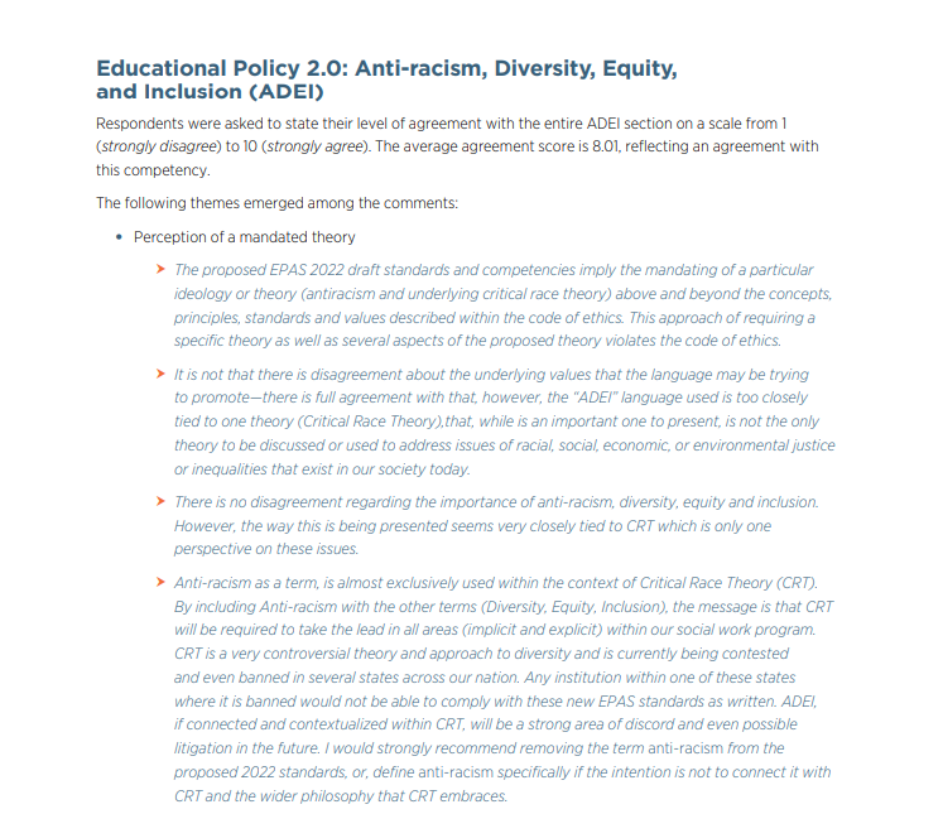
The CSWE, citing high numerical agreement scores, disregarded critical feedback and plodded along with its ADEI plans. Unmistakably, the organization’s ears were bent towards supporters.
“We are thrilled to see the intentional presence of anti-racist practitioners woven into the EPAS,” one supporter said. Another commented, “As shared previously, we are moving to the forefront of what social work means in today’s world. The impact of covid [sic] and racially charged oppression. It helps to know we are supported in our curriculum and field designs addressing these issues through social work education.”

In October 2021, a second draft was released for another round of public feedback, which included a survey that received “74 fully complete responses.” (A summary was unavailable for review.) By June 2022, the CSWE approved and released the final version of the 2022 EPAS, formally celebrating on July 15. The Standards went fully in effect on July 1, 2025, and ADEI became the name of the social work education game.
Recently, on January 23, the CSWE continued to defend the discipline’s slanted Standards as states clamp down on DEI ideology, maintaining that ADEI consists of the “highest professional standard.” Moreover, the CSWE asks programs to sneakily purge themselves of DEI language to stay in compliance with state and federal law while simultaneously enforcing adherence to ADEI principles.
As one survey respondent foreshadowed in 2021, social work committed—and is clearly doubling down on— a “radical move toward the left,” with an unfolding, foreseeably harmful impact on a politically diverse set of clients across American society.
Nathan Gallo, MSW, CNA is a recent Master of Social Work graduate and hospital nursing assistant based in Northern Colorado. He has written about the importance of cognitive liberty, tolerance and value pluralism in social work education. Gallo also led a case study article on medical aid in dying (MAID) and motor neuron disease, published in the flagship journal for this practice, the Journal of Aid-in-Dying Medicine.
Arnoldo Cantú, LCSW is a clinical social worker and psychotherapist with experience in school social work, private practice, community mental health, and primary care behavioral health seeing children, adolescents, families, and adults. Cantú was born in Mexico and considers Texas home having grown up in the Rio Grande Valley, though currently resides in the beautiful city of Fort Collins located in northern Colorado. He has been the lead and co-editor of several volumes in the Ethics International Press Critical Psychology and Critical Psychiatry Series. He’s written critically not only about the idea of so-called mental disorder, but also the idea of race categories.
Please don’t use the term, “liberal” to describe these actions. True liberals were Jefferson, Madison, Franklin etc. The behaviors including co-opting the language and changing its meaning to eliminate history exhibit the Marxist behavior that has replaced the once Democratic Party and their like. Read The Communist Manifesto or Saul Alinsky’s 12 Rules for Radicals. I learned this in my B.A. program in the 70’s.
I am reading this with great interest. We have always had conservative students in social work programs. I just retired from a 45-year career as an Endowed Professor of Social Justice. However, the widespread disdain for conservative students is relatively new and, I believe, tied to the automatic (and largely mistaken) assumption that they must be MAGA. Before this turn to making anti-racism the primary focus of the EPAS, my college generally handled students who clearly did not subscribe to the NASW Code of Ethics on a case-by-case basis related to our professional ethics.
Part of what is missing here are 2 facts:
1. This is not totally new. For many years, CSWE has exempted SW programs in religiously-based colleges from adhering to all of the previous EPAS standards. In the past, much of this related to beliefs and attitudes about abortion, which was then a "hot" topic for Christian-based programs.
2. The change in leadership at CSWE to a very small group of people who fully and unquestionably supported ADEI and the somewhat singular focus on race was largely responsible for this change. Once in charge, they pushed through the EPAS changes they supported and disregarded all feedback that did not align with their ideological stance.
I have personally been in charge of one self-study in my college and served as a self-study consultant for other programs. I have watched the EPAS change over the years. The current narrow, ideological change will not serve our social work students well in their eventual employment.
However, we cannot ignore the other extreme that is being enacted in conservative states. In Texas (where I live and taught), our University and College websites have been scrubbed of ALL ADEI content. All sections of a course I designed many years ago, "Confronting Oppression," were cancelled, and our syllabi for all courses in all colleges are fully online, where legislators (and others) can peruse them for banned DEI content.
I don't think that this has anything to do with a lack of strong documentation. It has to do, in my opinion, with the change in leadership to a small group of people who think alike and are not open to other ideas or feedback from anyone else.