Editorial Note: This essay is the third of five in which we do a “deep dive” uncovering what we believe to be the factors at play that influenced the Council on Social Work Education’s (CSWE) strong ideological bent, notably from 2020 onward. View the first essay here and second essay here.
“Comrades” at the Conference
“Independence is a myth,” charged a social work scholar at the Council on Social Work Education’s (CSWE) 71st Annual Conference in Denver, Colorado this last October. “It’s not about fitting disabled people into the capitalist, ableist structures,” she said, “but dismantling these collective structures of oppression so that all of us can...work towards collective liberation.” This same professor referred to her fellow panelists as “comrades” on at least three occasions.

Despite scattered applause and assuming to have the final progressive say, the overwhelming majority of the American public would sharply disagree, according to reports on hidden political tribes, shared ideals, and personal agency by More in Common—a research organization dedicated to helping the country find common ground.
In normal times, a professional educational conference does not warrant public attention. In normal times—with properly earned public trust—an education conference acts as an incubator for faculty and professionals to discuss the latest developments in their discipline. But this was a national gathering that sets the standards and educational content for money-paying, responsibility-bearing students joining the profession’s 700,000+ social work practitioners throughout the U.S.
The Conference, as the CSWE’s website describes, is “the preeminent annual conference for social work educators, students, deans, and directors worldwide,” with nearly 3,000 people in attendance. The most recent conference theme in 2025 was “Championing Disability Justice and Disability Joy in Social Work,” a theme that on face value appears relevant and important for a large segment of the population.
As the CSWE President and CEO Dr. Halaevalu Vakalahi, who commands a salary of over $300,000 (an income higher than that of pediatricians and primary care doctors, and almost ten times more than an entry-level social worker) put it: “The 2025 Annual Conference reaffirmed our collective commitment to inclusivity and action. Disability justice and disability joy are not peripheral to our work—they are central to how we create not only a more compassionate and equitable profession, but a better world.”

Upon closer inspection, those generous assessments missed the mark by a mile.
Social work is not (or should not be), by definition, politically progressive or radical. According to the U.S. Bureau of Labor Statistics, “Social workers help people prevent and cope with problems in their everyday lives.” A definition from the National Association of Social Workers, deleted from their site sometime after September 2017, describes social work neutrally as “a profession devoted to helping people function the best they can in their environment.”
However, this year, the CSWE’s ideologically progressive mandates sat in the background of the Conference—ones that schools were forced to comply with on July 1, 2025—a development we previously reported on.
The Conference’s Ideological Bent
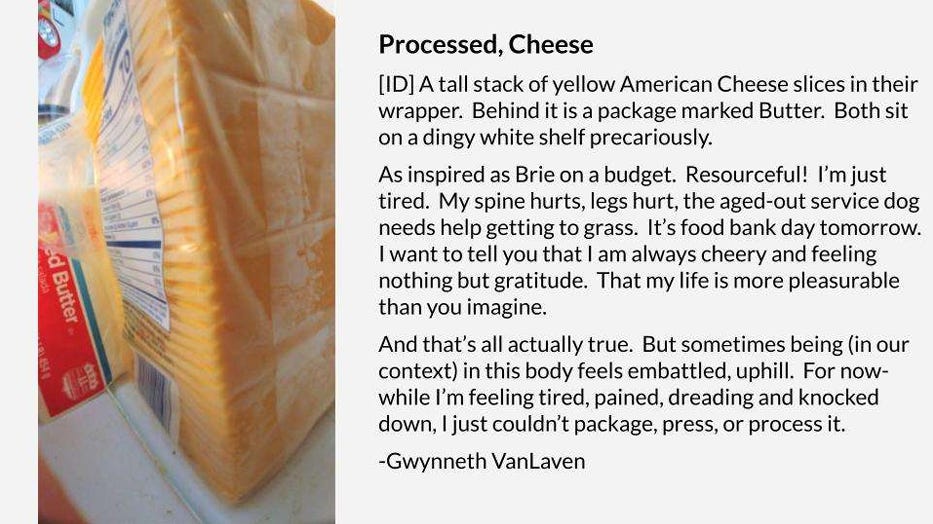
Practicality, political openness, and public relevance appeared to be scarce at the conference. For example, perhaps as a microcosm of the irrelevance, a photovoice project funded by CSWE Special Projects Fund and put together by the Council on Disability and Persons With Disabilities’ project contains a photo of cheese.