


Editorial Note: This essay is the final out of five in which we do a “deep dive” uncovering what we believe to be the factors at play that influenced the Council on Social Work Education’s (CSWE) strong ideological bent, notably from 2020 onward. View the first essay here, second essay here, third essay here, and fourth essay here.
The Lie of “Inclusion”
“Social work is for everyone. No exceptions.”
So proudly proclaimed the Council of Social Work Education (CSWE), social work’s national accrediting body, in its 2024-2025 Annual Report. And yet, there are, in fact, several contemporary “exceptions” seemingly lambasted or dismissed by social workers, encouraged by the field’s ideological slant:
“White dudes” in the social work classroom
Everyone who bears the “insidious nature of Whiteness”
There is also a near-endless list of individual “exceptions.” Because social work endlessly spins the oppressor/oppressed, group-identity wheel like a 1970s game show, we refer to self-reported group identities here, instead of individual names:
A Sengalese pro-capitalist who rejects colonization as an explanation for Africa’s poverty.
An Indigenous non-activist who considers the full political spectrum within the self-described Indian community.
A Black conservative who is skeptical of the utopian, fallacious promises of social justice.
A transgender economist who connects liberalism and freedom with societal prosperity.
A former foster home youth who argues for the importance of a stable family life.
A Jewish social work professor who believes in the promise of universalism and humanism.
A Mexican-American psychotherapist who rejects the “White-BIPOC” demarcation and racial categories.
A “double minority” nursing assistant who rejects identity-based, rights-driven progressivism without full exposure to competing ideas.
A German-American political scientist who criticizes the dominance of identity politics.
A British inner-city headmistress who emphasizes hard work and grit for schoolchildren.
A Cuban-born writer who is skeptical of the creation of “Latino” and “Hispanic” identities.
A gay, British writer who advocates for the return of political liberalism.
A New Zealand-born philosopher who is critical of the current form of progressive feminism.
A Black liberal professor who takes issue with identity politics and contemporary anti-racism practices.
A Black, gay immigrant critical of race‑based and identity‑based politics for fostering a sense of victimhood.
A Black economics professor who is critical of the Black Lives Matter movement and endorses a race-blind philosophy.
A Russian-born immigrant who argues for preserving an open, tolerant society.
A Hungarian sociologist who argues for the importance of conceptual and political borders.
An Iranian-born Muslim-turned-atheist-turned-Catholic who advances the importance of spiritual meaning.
A Zambian macroeconomist who is skeptical of the positive utility of foreign aid in Africa.
A Brazilian libertarian who supports the importance of economic education.
A Black philosophy student who rejects the myth of settler colonialism.
An Italian-American DEI-critic who argues that fixing perverse economic incentives, not compassion, could ameliorate the homelessness crisis.
A Black lesbian who rejects identity-based social division.
The strongest “exception,” by far, is anyone skeptical of diversity, equity, and inclusion (DEI) policies, within and outside of social work education. Instead, ignoring disagreement, the CSWE redoubled its pledge to support these ideas: the organization’s declaration that the profession includes “everyone” appeared on the same Annual Report page that described DEI as “core values” (see screenshot).
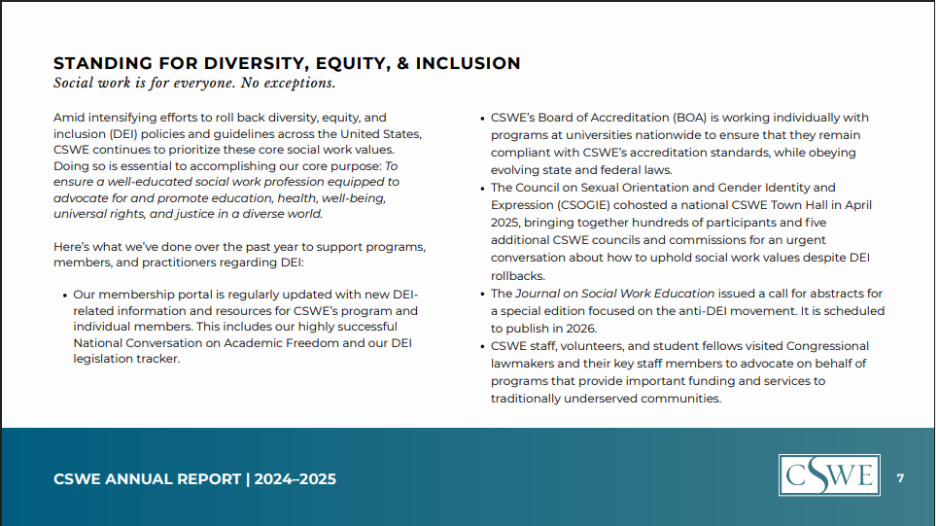
This is effectively akin to trying to pick up a wooden plank while standing on it—superficially advocating for diversity and inclusion while hypocritically excluding certain people and ideas at the same time.
The Lie’s Professional Spillover
A week after publishing the Annual Report, the CSWE released its vision for national social work education in a 2026-2030 Strategic Plan, recommitting itself to what we see as an exclusionary, ideological set of progressive values (held coincidentally by a small group of Americans); that is, anti-racism, diversity, equity, inclusion, and belonging (ADEIB). The organization preemptively congratulated itself for upholding these ideologically tilted values: “Social work students are the future of the profession, and the workforce is ready to meet them.”
As former graduate students and current healthcare professionals, we question whether the U.S. workforce is “ready” to meet DEI-captured students whose critical thinking skills have been corroded, who prioritize consciousness-raising over the dignity and worth of the person in front of them, or who can only view the world through a simplistic, dichotomized, and disingenuous lens of power.
We also question whether the workforce is “ready” to meet students who pursue a “prochange mandate” at all costs—and are unprofessionally trained in the techniques of permanent political struggle—instead of abiding by relevant laws and policies.
Finally, we question whether the workforce is “ready” to meet students who, starting in 2022, underwent two-to-four years of “resocialization” to learn to shame themselves and one another about “White comfort” and “White supremacy”—ideas they will take with them and apply to clients with an untold number of psychological harms.
From the outside, a member of the public could be forgiven for believing that little has changed in the past five years, much as we did when we returned to school. Social work in the United States continues to be a well-regarded mental health profession, according to a 2023 public opinion survey from the National Association of Social Workers (NASW). (As it stands, social work will continue to operate as a key part of the workforce, despite recent classification changes from the Department of Education.)

From the inside, however, the CSWE and its coterie of national social work programs have taken the language of “everyone” to shift professional education into ideologically captured activist education through the discipline’s 2022 Educational and Policy Standards (EPAS). Across the country, Bachelor-level students now get to learn how social work falsely includes “everyone” as they end their programs with an average of $33,000 in loans, while Master-level students finish with an average of $40,000, according to the CSWE’s annual survey of social work programs.
Nor have these changes stopped with education. Organizations like the CSWE and the National Association of Social Workers (NASW) now “use ideologically loaded concepts to pressure practitioners into incorporating political ideologies into their work,” as Nafees Alam, a sports social worker, puts it in the Journal of The Open Therapy Institute.
This pull toward ideological conformity rather than professional neutrality, as Alam describes, comes “in ways that impinge on the equal treatment of clients, client autonomy, and respect for the diversity of clients’ values.”
In the working world, the CSWE’s transformation of professional education into an incubator for an illiberal class of activists will likely accelerate what author Naomi Schaefer Riley observed in 2024:
Many public and private agencies are having difficulty finding qualified employees, and the politicization of the field is making things even harder.
Certainly, we question whether social work will continue to remain the fastest growing profession in the country if the field merely “become[s] a destination for people who want to get paid to be protesters,” as Schafer Riley says. Worse still, we question how social workers will fare with unrealistic conversations about being five times more likely to suffer a serious workplace violence injury than those in other sectors.
Social work in the 2020s is indeed for everyone. For everyone with rightthink and rightspeak.
Nathan Gallo, MSW, CNA is a recent Master of Social Work graduate and hospital nursing assistant based in Northern Colorado. He has written about the importance of cognitive liberty, tolerance and value pluralism in social work education. Gallo also led a case study article on medical aid in dying (MAID) and motor neuron disease, published in the flagship journal for this practice, The Journal of Aid-in-Dying Medicine.
Arnoldo Cantú, LCSW is a clinical social worker and psychotherapist with experience in school social work, private practice, community mental health, and primary care behavioral health seeing children, adolescents, families, and adults. Cantú was born in Mexico and considers Texas home having grown up in the Rio Grande Valley, though currently resides in the beautiful city of Fort Collins located in northern Colorado. He has been the lead and co-editor of several volumes in the Ethics International Press Critical Psychology and Critical Psychiatry Series. He’s written critically not only about the idea of so-called mental disorder, but also the idea of race categories.
There never should have been clinical social work. Social work is social work. I believe it happened because the females in hospitals threatened their male doctor bosses for more money and status. So, they threw them a bone.
“We also question whether the workforce is “ready” to meet students who pursue a “prochange mandate” at all costs—and are unprofessionally trained in the techniques of permanent political struggle—instead of abiding by relevant laws and policies.” You both rightfully express a concern in the social work field, and I value professional competence. Well done!